Word of the Week! Cryptolect

WhisperThis septic tank needed a glass of Vera Lynn after a bit of rabbiting about the brass tacks of Jah Rule next year.

I’ve just used the most famous cryptolect, Cockney rhyming slang, to tell you that I’m a Yank who needed his martini after talking about the facts ahead for our school year.  You might, if you are a certain age, have guessed “brass tacks,” but the other terms, I’m guessing, remained confusing. None so much as “rabbit” for “talk,” since the mystery term is shortened from “rabbit and pork.” There are so many invented languages, many of them merely collections of slang, that mark membership in a subculture. Some like Thieves’ Cant have a long and rich history and crossed oceans: you might know what a “mark” is if you watched enough classic crime drama.

Such a secret language may be intended to conceal its meaning from outsiders (the “crypto” connoting secrecy); thieves don’t want their marks to know that they are about to be conned. It appears ironic that crytpocurrency is as likely to be used by criminals as law-abiding citizens.

Speculative fiction is full of invented languages; I’m not thinking so much of the complete systems that J.R.R. Tolkien developed but rather the English dialect of a cult of asteroid-dwelling primitives called “The Scientific People” in Bester’s The Stars My Destination or the post-nuclear English of Hoban’s Riddley Walker. The new dialects have an internal logic and convey membership in the group.

We need not travel to the future or distant worlds to find cryptolects. If your own family has terms that convey an entire story but that remain inaccessible to outsiders, you use a cryptolect.  My father refused to teach his children Arabic, save for certain words and terms he wanted to use in various settings, so he could convey a message, secretly, around anyone not in our extended family.

Despite an ancient history and promising future, the word of the week is itself a newcomer. The OED gives earliest recorded uses from the 1980s.

As always, please send us words and metaphors useful in academic writing by e-mailing me (jessid -at- richmond -dot- edu) or leaving a comment below.

See all of our Metaphors of the Month here and Words of the Week here.

Creative-Commons Image “Whisper” by Jamine Gray at Flickr.


Word of the Week! Unprecedented

HimalayasProfessor Joe Hoyle gave me a word that helps out in my ceaseless war against the word “super,” that boring and overused adjective that I consider lazy in speech, unacceptable in writing.

We have experienced an unprecedented health crisis, at least in our lifetimes; no one living can recall the 1918-19 Spanish Flu. So in many media reports, from unemployment claims to clear air over Indian cities (pictured) to empty New York streets, we see the adjective “unprecedented” appear. To say that “Indians enjoyed unprecedented views of the Himalayas” is not, however, correct unless a person were under a certain age. Residents of Indian cities are, however, experiencing cleaner air and distant views, the best in 30  years.

That’s not the same as “unprecedented.” “Unprecedented in his lifetime” might qualify matters.

Our word means without precedent.

Where does it come from? To my ear at least, it sounds modern. I would, however, be wrong. The OED provides a first recorded usage of 1641. The word precedent, itself, is Latinate and thus, with ancient roots.

Be careful, as with any “super useful” word, not to overuse our word of the week. Soon, its currency will reach unprecedented levels. Reach deeper into the dictionary for words such as “extraordinary,” “novel” (the virus is called a novel coronavirus, since it’s a never-before-encountered form), “unique,” “unparalleled,” or other exact or near synonyms.

Please send us words and metaphors useful in academic writing by e-mailing me (jessid -at- richmond -dot- edu) or leaving a comment below.

See all of our Metaphors of the Month here and Words of the Week here.

Word of the Week! Grocer

Sainsbury's Checkout LineLet’s face it: the supermarket has dominated our lives lately. It’s one of the few places we can go without too many restrictions. We might even call it “the grocery store,” though many today sell everything from clothing to sporting goods: a giant Walmart does, itself a super-sized version of the General Stores of the early 20th Century. Yet when we think of “groceries,” we think of food and household items.

These stores, in the States at least, go back to Giant Open Air and similar in the 60s. My father was stunned that you could buy tires or a steak under the same roof. At our local Giant Open Air, you could even pick out a steak and have it cooked for you while you watched. Now, restaurants are common in big stores. Wegmans here has a Pub, a Coffee Shop, and a Cafeteria.

Only in the UK, when I encountered the “Greengrocer,” a produce-seller nearly (and sadly) extinct thanks to the giant supermarkets there, too, did I begin to question what a “grocery” was and where it came from. More recently, an article in The Atlantic about the pandemic and its long-term effects on the grocery industry got me interested in this word.

Picking “grocery” apart when saying it comes up with “gross,” and not in the sickening sense, but the sense of something sold in bulk. We trace the word back to Latin grossus, through Medieval Latin and French to get “grocer,” the merchant who sells things in bulk. Our word goes back at least to the 14th Century, as the OED outlines it.

Before the modern era of packaged goods, that is what folk did: pounds of this, dozens of that.  How “gross” also came to mean “disgusting” should be the subject of a future post.

May I admit a certain obsession with grocery stores? Why do I spend time wandering about not only stores, but Groceteria, a site about their history?

My father was a produce wholesaler, after years of driving a produce truck, so I spent hours in various stores, a delight to a kid hoping for a candy bar. In my teens I bagged groceries for the old Food Fair / Pantry Pride chain. It’s nigh impossible to find images of these quotidian, largely forgettable stores. The best I could do is this shot, with “gross” quantities of food on view, from the Food Fair in the now demolished Azalea Mall of north Richmond. That’s a lot of country ham.
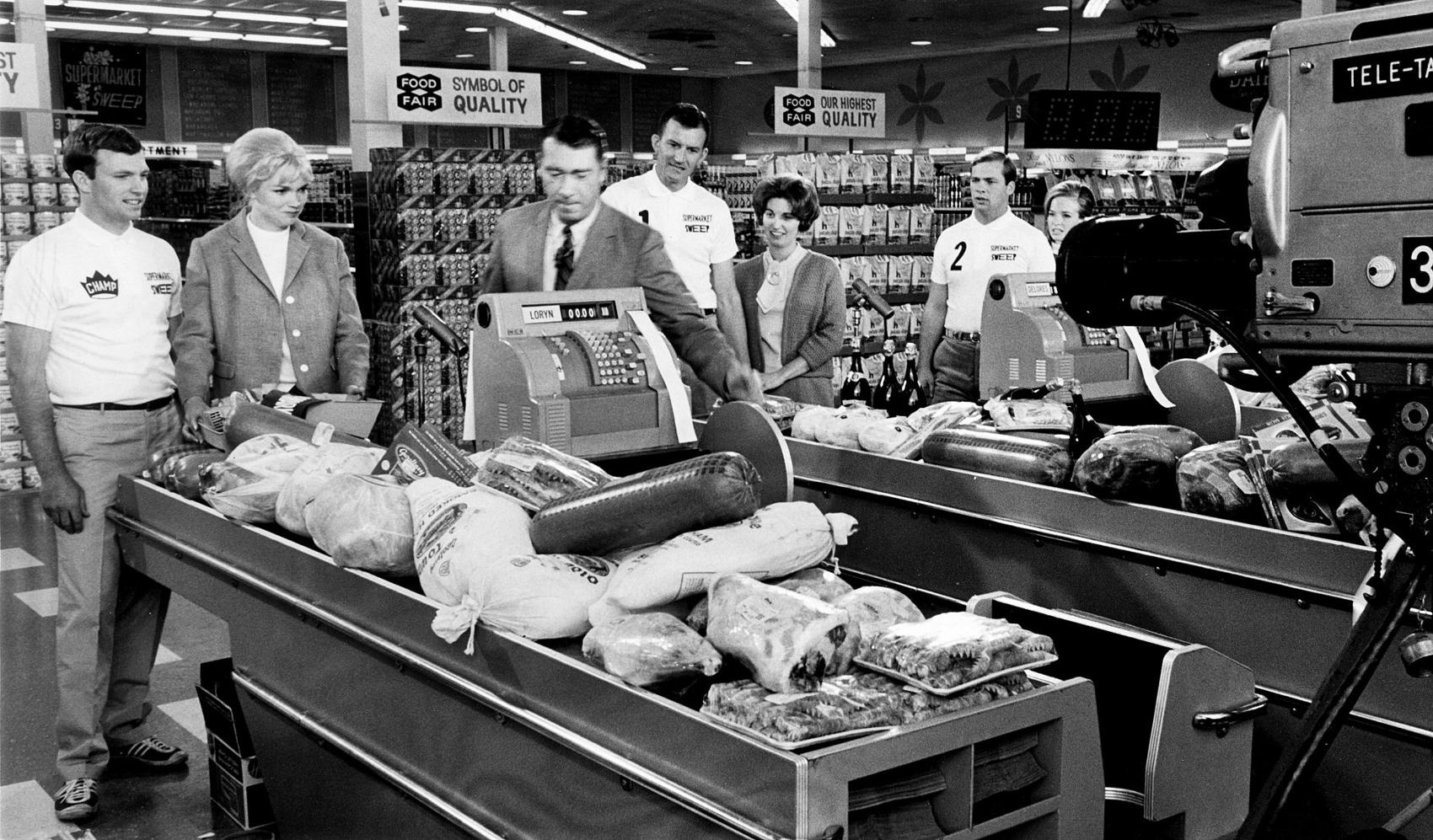
Azalea MallThe caption here: In October 1966, the television game show “Supermarket Sweep” visited the Azalea Mall Food Fair for a taping. Before an audience of 300, contestants attempted to guess the correct prices of grocery items in order to win minutes of shopping for free merchandise. Bill Malone, behind the register, was the host of the show.

These were formative experiences, in an era when a cashier could earn a living wage and even retire from a chain store. I always make a point to visit grocery stores in other nations, at least to get things for a picnic. I have learned more about a culture from its grocery stores than nearly anywhere else.

I do wonder how grocery-shopping will evolve in coming years. Will “groceries” come to refer to those things we use at home, delivered to us? Or will we need an adjective for what is perishable, not easily delivered to our doors? Of will grocery-shopping in person wane completely, with modern-day counterparts (perhaps, robots) of the egg, milk, and bread delivery people returning to what was done before supermarkets offered one-stop shopping?

That is for futurists and the Market to consider, not a blog about words. But enjoy your shopping, and may your choices be plentiful and your carts full.

Please send us words and metaphors useful in academic writing by e-mailing me (jessid -at- richmond -dot- edu) or leaving a comment below.

See all of our Metaphors of the Month here and Words of the Week here.

Image courtesy of Wikipedia; Sainsbury Store. U.K., where I’ve done my share of grocery shopping.
Word of the Week! Exemplar

Bob HooverEvery year, faculty nominate a graduating senior in our program as Writing Consultant of the Year.  Our student should have shown a real commitment to helping student writers and the ability to communicate well and do hard work when facing adversity (and a pile of drafts to read does build character!).

We have a winner, to be announced in a post later this week, but I wanted to explore a word that I link to excellence, high points, peaks.

We have many: paragon, aegis, the somewhat obsolete eidolon. This week’s word, though, has as its virtue sounding both ordinary and a trifle exalted. We recognize its lexical cousins: example, exemplify, excellent. And while some examples can be bad, exemplars are not, at least in the uses I found. Merriam Webster’s online example makes it clear that this is an example to follow, an ideal. To do something exemplary is to act as an exemplar, to do something admirable.

While hunting down a Creative-Commons image for “exemplar,” I discovered that the US Air Force Academy annually recognizes an Exemplar that an entering cadet classes wishes to emulate. I found the 2020 winner, Bob Hoover, one of my favorite pilots; Hoover was famous for his service in World War II, his competitive spirit in air races, and was longtime friend of his squadron mate, General Chuck Yeager. To qualify, “[a]n Exemplar must have exhibited integrity and character in both their professional careers and their personal lives.”

Our word sounds Latinate, so I will take us to the OED, my source for etymology. Partly true! There’s an Anglo-Norman ancestor in play, too. In Latin, it’s a model, an ideal, and much more besides.

We could use more exemplars and exemplary behavior today. Fingers crossed for lessons well (and harshly) learned.

Please send us words and metaphors useful in academic writing by e-mailing me (jessid -at- richmond -dot- edu) or leaving a comment below.

See all of our Metaphors of the Month here and Words of the Week here.


Word of the Week! Earwig

See speak hear no evilProfessor Joe Hoyle in the Business school sends us this week’s word, noting “I’ve been reading To The Lighthouse recently and [author Virginia Woolf] uses the word, ‘earwig’ on several occasions.  That’s one that I liked.”

I read the novel a decade ago, and Woolfe’s use of language enthralled me, yet that word did not stick, as “noisome” has during my reading of Ackroyd’s London: The Biography. Yet when a word gets employed enough by a talented author, there’s clearly a reason. So why “earwig”? She did not mean the insect reported, without any real evidence, of crawling into a human ear.

Instead, we turn to metaphorical usage of the the term, one that seems to have morphed into “earworm.” Most commonly, that means a piece of music that gets stuck in our heads. How that wig became a worm is beyond the scope of a short post, but it’s an interesting evolution. At one time, as the OED entry proves, “earworm” and “earwig” were synonyms. I like it that in this case, the two words diverged and added nuance to the language.

In its original and derogatory sense, an earwig could be a person who bends your ear to whisper lies or spread gossip to malicious ends. Try as I might, we don’t have a good term in formal English for such a nasty gossip today; Tolkien’s wicked counsellor Wormtongue provides a neologism that I really love. In any case, the obsolete definition for “earwig,” dating from the 15th Century, appears in the OED entry for the insect.

To get at Woolfe’s meaning, she might have been after the verbal definition of our word, the action of being an earwig, to pester someone, to fill their head with wicked insinuations or outright lies.  While the usage rarely occurs (2 of 8 on the OED’s usage scale) the concept is very much with us. If someone we call an “Influencer” spreads ridiculous notions or outright evil ideas, they are trying to earwig us. Stop your ears before bad ideas worm their way under your wig…

Please send us words and metaphors useful in academic writing by e-mailing me (jessid -at- richmond -dot- edu) or leaving a comment below.

See all of our Metaphors of the Month here and Words of the Week here.

See, speak, hear no evil, courtesy of Wikipedia.

Word of the Week! Noisome

London Slums: Dudley StreetThe WordPress spammers are back, purportedly offering praise for these posts but really trying to hawk odd services for obscure software applications, some rife with viruses of the non-Corona variety.

It’s all noisome to me. Today, when someone employs that word, it’s likely to mean something that stinks, literally. Our word once had a broader meaning than the OED’s “Offensive to the sense of smell; foul-smelling,” which itself is a rather old usage, reaching back to the 1600s. Early meanings included things that were simply offensive, even, in an obsolete meaning mentioned in the OED, “Harmful, injurious, noxious.”

You just click some of those spammers’ links. I guarantee they may be harmful to your computer’s continued operations. Noisome!

I ran across our word while reading Peter Ackroyd’s London: The Biography.  The author likes the word as much as I do: I’m barely 100 pages in, and I have found three instances. Here’s my favorite:

“London has often been characterised by the noise that is an aspect of its noisomeness.”

If you know London, its noise can indeed rise to the point of being offensive, almost like a terrible smell.  New York noise is different, if no less jarring. Ackroyd chose his terms well here. Eventually, like the smell of a foreign city, the noisome noise of London simply becomes part of the background. In 2018, when we left London for Salisbury at Christmas, we were amazed at the quiet of the smaller city, especially at night.

This week’s word needs a bit of a revival. In the broad sense of being annoying, “noisome” could describe many of the daily indignities of modern life.

Please send us words and metaphors useful in academic writing by e-mailing me (jessid -at- richmond -dot- edu) or leaving a comment below.

See all of our Metaphors of the Month here and Words of the Week here.

Image of Dudley Street, London, courtesy of Wikipedia Commons


Word of the Week! Altruism

A helping handRarely to I begin a post with a full definition from the OED, but for this word, I shall:

“Disinterested or selfless concern for the well-being of others, esp. as a principle of action. Opposed to selfishness, egoism, or (in early use) egotism.”

This sentiment, so at odds with the stock-market panic and hoarding now underway, should remind us of better times past and, yes, ahead once the fevers, real or anxiety-born, die down.

The entry at the OED gives us a good sense of where our word comes from, and it’s a loan word from the French altruisme. Curiously, it only dates to the mid-19th Century in English. Certainly, as any novel by Dickens attests, people were not all Scrooges and Mister Bumbles back then, or earlier.

Later formations are altruist, for one who practices altruism, as well as the slightly earlier altruistic.

Right now might seem a dangerous time to be selfless. What small acts of altruism have you practiced during this emergency? Which will you practice?

I saw a lot of altruism this week among my Writing Consultants at the university. We resume remote learning next week, so many of my student employees put their elders to shame, stepping right up to help students with their papers, regardless of their current job duties.  Don’t make fun of “Gen Z” until you have been around more of them. They are kinder than we old fogies. Good thing, that.

Please send us words and metaphors useful in academic writing by e-mailing me (jessid -at- richmond -dot- edu) or leaving a comment below.

See all of our Metaphors of the Month here and Words of the Week here.

Image “A Helping Hand” courtesy of Wikipedia Commons.

Word of the Week! Quarantine

quarantine station 1957Here we are, self-isolating as the university gets ready to resume learning, by distance and technology. Even if you are not in a medical facility or ill, you are effectively in quarantine.

I was curious, in these troubled times, about the origin of our word, in both noun and verb forms. The OED entries reveal that the verb is a 19th-Century back formation (without any changes) from the noun. That older word, a borrowing from both French and Latin, dates to the 15th Century and probably earlier to pre-Gutenberg times.

Obsolete meanings from the OED refer to religious fasts, including the 40 days of fasting Jesus endured. More modern uses are quite familiar as COVID-19 works its evil magic, such as “isolation imposed on newly arrived travellers in order to prevent the spread of disease.”

As with many useful words, this one gets employed metaphorically, for legal, technological, and other purposes. May your quarantines all be short and our return to campus speedy.

Ill or healthy, I can still type, and this blog will soldier on as we cope with the emergency.

Please send us words and metaphors useful in academic writing by e-mailing me (jessid -at- richmond -dot- edu) or leaving a comment below.

See all of our Metaphors of the Month here and Words of the Week here.

Public health station, New Orleans, 1957, courtesy of Wikipedia.

Word of the Week! Pandemic

pandemicHere I sit, barely able to stay upright, mending slowly from perhaps the worst sinus infection I’ve ever had. This malaise got to me thinking about how we classify disease outbreaks. The COVID-19 virus would be considered an epidemic, or a disease “prevalent among a people or a community at a special time, and produced by some special causes not generally present in the affected locality.” If you are in Wuhan, it’s much worse, but I was amazed to see several people in my doctor’s office wearing surgical masks. My pharmacy displayed a sign reading “SOLD OUT of face masks.”

Folks are clearly afraid that the Chinese outbreak could jump borders and become a global pandemic, or an “epidemic over a very large area; affecting a large proportion of a population,” much like the Spanish Flu of 1918-19. The CDC estimate of US deaths for that pandemic runs to 675,000. I’ve heard figures as high as 50 million for the global death toll. A third of the world’s population fell ill.

Both terms have earliest recorded usages in the 17th Century. Since then, modern hygiene and advances in medicine have helped to make pandemics rare, if still terrifying, events.

The CDC provides a very useful chart that differentiates seasonal influenza, an annual event, from pandemic flu, which happened three times in the past century.

Pandemics lead to irrational behaviors that can worsen an already critical situation. I hope you are washing your hands a lot. That’s much more effective than wearing a mask.

Please send us words and metaphors useful in academic writing by e-mailing me (jessid -at- richmond -dot- edu) or leaving a comment below.

See all of our Metaphors of the Month here and Words of the Week here.

Image of soldiers at Fort Riley, Kansas, during the Spanish Flu Pandemic, courtesy of Wikipedia.

Word of the Week! Pettifogger

image of pettifoggerBusiness-School Professor and wordsmith  Joe Hoyle asked about this term, a timely one since it got bandied about during the Senate’s recent impeachment trial. It dates back to the 16th Century and has a nice origin, compounding “petty” with the word “fogger,” a forgotten term that may refer to “the surname of a family of wealthy mercantile bankers and venture capitalists from Augsburg, Germany.”

A “fogger,” according to that same entry, came to mean a “a low-ranking lawyer who abuses the law” but that usage petered out in the 19th Century. The term has a more modern synonym, shyster, that is with us still, in deed and word.

For our word it seems redundant to add “petty,” for small,  but it accomplishes two things. First, as my students learn in the bestselling writing text, They Say / I Say: Moves that Matter in Academic Writing, it’s acceptable practice, as the authors put it, to repeat oneself “with a difference.” Adding “petty” emphasizes how petty that fogger really can be.

Less seriously, the compounding gives us the ability to engage in some wonderfully Southern-sounding alliterative curses, such as “You, sir, are no more than a pusillanimous and picayune pettifogger plundering the public purse!”

How did I do? The word “pettifogger” had legs enough to breed what are called “back formations” in our language: the verb “pettifog” and gerund “pettifogging.” I guess dubious legal practices for small coin never go out of style.

Perchance pettifoggery promotes puerile punditry? Okay, I’ll stop. At least until next week.

Please send us words and metaphors useful in academic writing by e-mailing me (jessid -at- richmond -dot- edu) or leaving a comment below.

See all of our Metaphors of the Month here and Words of the Week here.

Sleazy lawyer image, “Reptilian” courtesy of Jeremy Sternberg.