 A feature story I spotted in the lifestyle section of a major news outlet mentioned “leveling up” the reader’s cooking skills.
What a strange world of ours. A niche hobby for geeks in the 70s and 80s, when I discovered it, has become so mainstream that it gives us a term for self improvment.
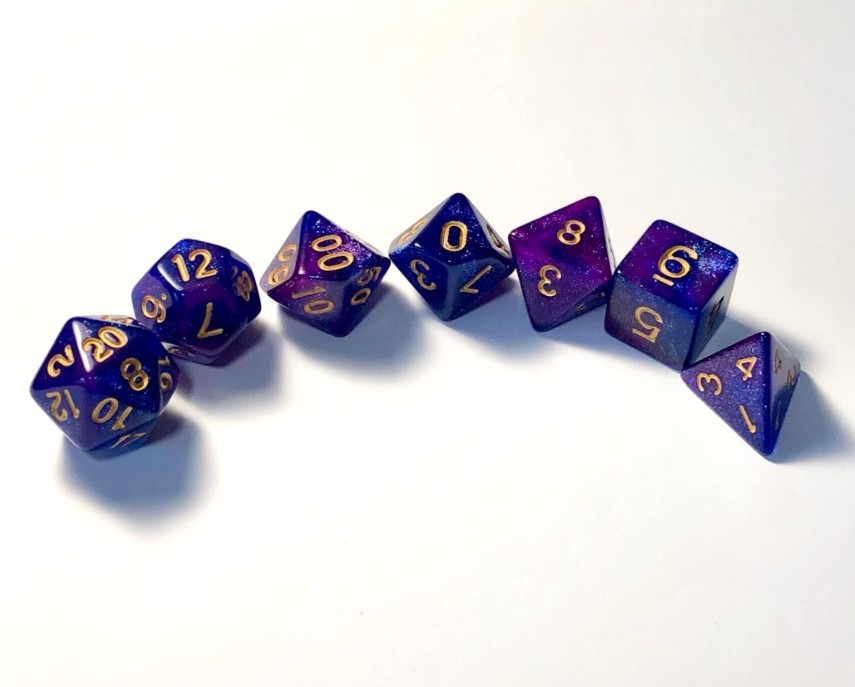
The tabletop roleplaying game Dungeons and Dragons probably needs little introduction. Just in case, however, you can read the history of Gygax and Arneson’s brainchild. Some basics: players create a character in a fictional world of fantasy (usually a sword & sorcery Conan or high-fantasy Middle Earth setting) who begins as a novice thief, warrior, cleric, mage, or other profession. The characters who survive their adventures, moderated by a Game Master (GM) with rules and multi-sided polyhedral dice, gain “levels” of experience.
Perhaps played over many years or even decades of real life, a well-crafted “campaign” of adventures becomes an act of collaborative storytelling.
I never liked the D&D game system, since poor gameplay might boil down to “I am Sir Hardhelm, a 15th level Fighter! You’ll never defeat me!” I prefer systems where one does not wear one’s abilities and personalities, so to speak, on robes or shield. Yet the idea of “leveling up” is now everywhere in print. It has become a cliche. I see it in corporate literature, news stories, and feature pieces even in Atlantic. Nary an Elf or Orc to be seen.
I no longer play D&D, though I do enjoy other simpler, less-binary rules for science-fiction or fantasy settings, such as Savage Worlds, promising “fast, furious, and fun!” gaming. It uses those dice plus playing cards to introduce randomness I found missing in D&D, even 40+ years ago in college. Nearly every week, my team of players, both old-time D&Ders with graduate degrees, outsmart me, their GM, during our two-hour Nerd Night.
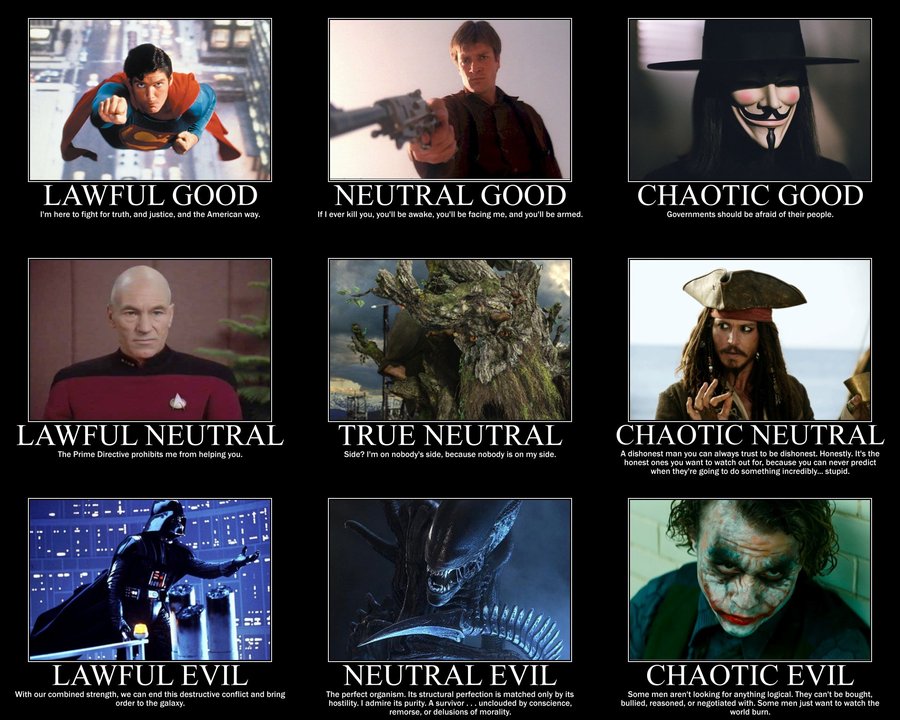
Despite my distaste for D&D’s system, we must give the game its due; it gave birth to many other games and rules systems, including my favorite that lacks levels or alignments of personalities. D&D’s moral alignments too are close to becoming cliches. You can see D&D’s nine pigeonholes on this chart, a Creative-Commons image from Hogan Hayes’ Blog “How We Argue.” Many versions can be found with a simple search, but any chart with Mal Reynolds from Firefly makes my personal cut.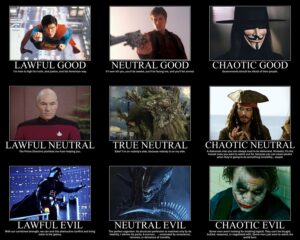
In our real world, no human I’ve met fits these templates neatly. Some come close, but I prefer to think of us as a stew of good and bad character traits. Savage Worlds builds that into character development, so you could have, for instance, an evil starship captain I created as a non-player character in the far future: he collects artwork without stealing it and adores playing the cello. He will spare and even aid others, including enemies, who share his joy when hearing or performing classical music. Otherwise, you might end up being tossed out an airlock without your space suit, just for giggles.
I’m pleased, in a way, that my many hours of time spent playing role-playing games has been vindicated by the masses. Celebrities play D&D during YouTube videos.
 I like not only embracing parts of geekdom but also seeing them emerge as a key elements of pop culture. Gaming with other humans, as compared to playing video games, was (and remains) for me a fun hobby when indulged in moderation.
Yet all those years of playing D&D taught me a thing or two about…when to stop (X-Files reference for the truly geeky). We all know youngsters who didn’t and squandered personal relationships, GPAs, and job opportunities to the allure of rolling those polyhedra dice and acting melodramatic while speaking in strange accents such as “You again, Looftar the Lord of the Stinking Horde? Begone, vile jelly! Unhand the fair Elven Princess Willowand! Verily, begone, I say!”
No, I never said that. Well, not exactly. May you always make your saving throws this Spring!
Help me to level up this blog with new words and metaphors. Send them my way by e-mailing me (jessid -at- richmond -dot- edu) or leaving a comment below. Want to be GM for a week and write a guest entry? Let me know!
See all of our Metaphors of the Month here and Words of the Week here.
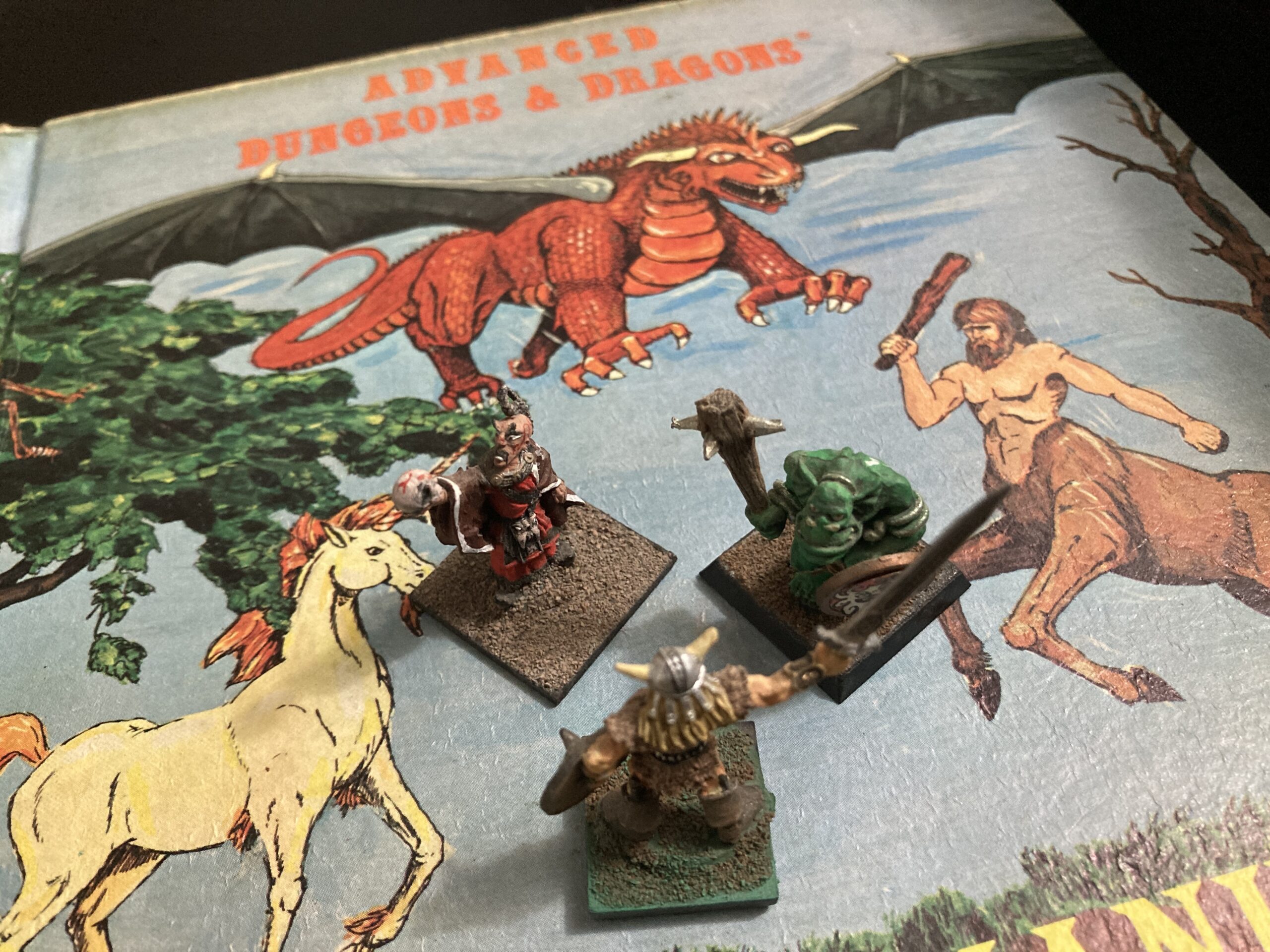
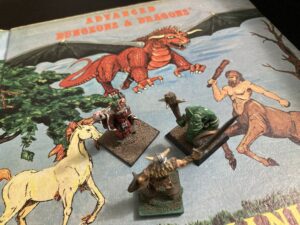
Images: Dice from Wikipedia, bottom image from my collection of old D&D stuff.
 We are in the process of switching brands for the dry kibble we feed our three livestock dogs. The dogs are huge, each over 100 pounds, and they eat a LOT of food. Our current brand, which I won’t name, began selling 38-pound bags for the same price as an older 50-pound bag.