Word of the Week! Charlatan

Snake Oil SalesmanOur trivia team, “Electric Mayhem,” got stumped by this word this week, so I decided I’d cover it.

Our trivia-host stated that he wanted a term that came from the Italian word “to babble” for a type of confidence man. We wrote down this week’s word, but we figured that the origin of our word was French, so we erased it. We’d have still lost that round, and so it goes.

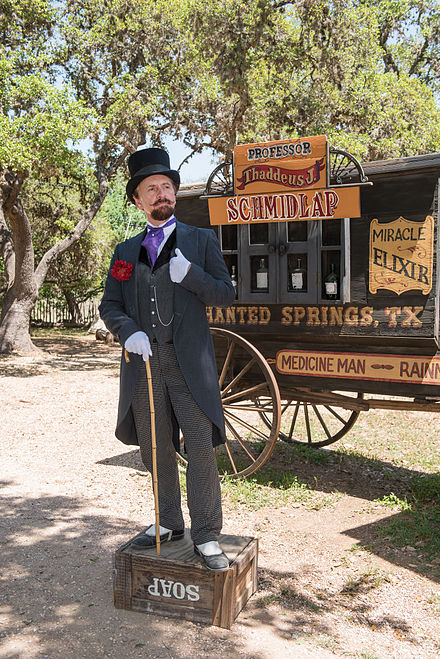
Like “Montebank” that I’ve covered here before, this week’s work is of Italian parentage yet it shares French roots as well. I’ll use the same image. Whereas Montebank comes from the monta in banco, “to stand on a bench” TO sell that snake-oil, “Charlatan” has a more complex etymology. From The Etymology Dictionary Online:

“one who pretends to knowledge, skill, importance, etc.,” 1610s, from French charlatan “mountebank, babbler” (16c.), from Italian ciarlatano “a quack,” from ciarlare “to prate, babble,” from ciarla “chat, prattle,” which is perhaps imitative of ducks’ quacking.

Today we have charlatans online, promising us miracles. We have others in positions of great power. We have many who blog. I hope this post, at least, might babble a bit but present you with an accurate origin on a still-popular word.

Send words and metaphors my way by e-mailing me (jessid -at- richmond -dot- edu) or leaving a comment below. Want to write a guest entry? Let me know!

See all of our Metaphors of the Month here and Words of the Week here.

Image of “Professor Thaddeus Schmidlap, resident snake-oil salesman at the Enchanted Springs Ranch and Old West theme park” courtesy of Wikipedia, via the Library of Congress.
Word of the Week! Blizzard

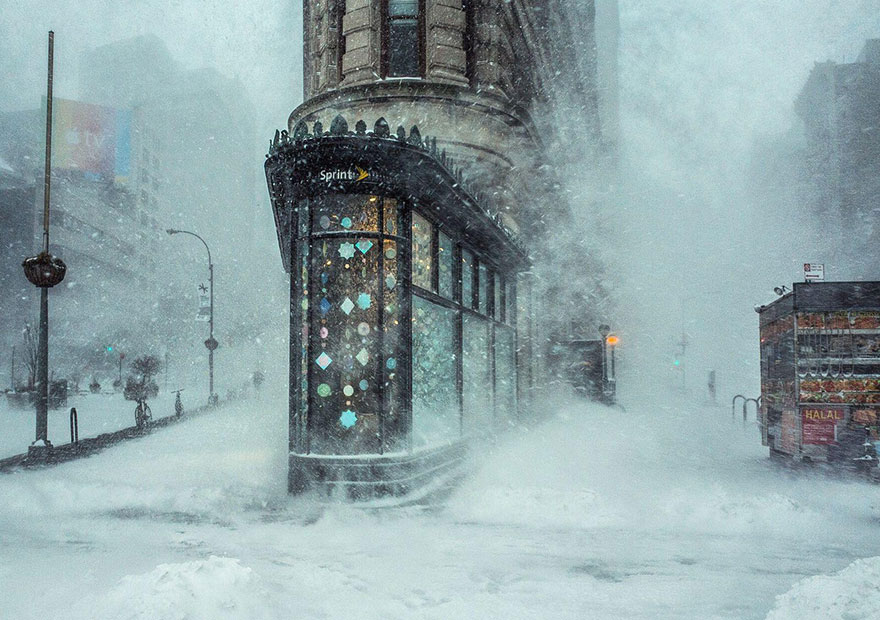
Blizzard conditions, 2016, Flatiron Building New York CityBlizzard conditions rarely appear in this part of the Mid-Atlantic, but one never knows. My undergrad students, who too often live their lives from day to day (ah, youth) don’t check the weather. They may wish to cast an eye on the forecast this weekend. While we may not get an epic fall of snow, we might get wind and very low temperatures.

Some will call that a blizzard. I would not. I “enjoyed” blizzard conditions exactly once, trying to drive a car ill equipped (’77 Volare, if I recall) that belonged to other folks from Bloomington, IN to Edwardsville, IL. The Interstate was coated with snow, which for a rear-wheel drive car wasn’t too bad. The wind was so strong, however, that it moved us around and created whiteout conditions. At 20mph or so, it took is all day to reach our destination.

What is a blizzard, technically? Etymology Online, where I went for the history of the word, has it as a “strong, sustained storm of wind and cold, and dry, driving snow,” which could described what we see from Saturday into Sunday in Virginia.  The term is of American origin, with its sense of snowfall dating to 1859. Older uses of the term, perhaps related to the comfy term “blaze” appeared earlier, meaning  ” ‘a violent blow,’ also ‘hail of gunfire’ in American English from 1829, and blizz “violent rainstorm” is attested from 1770.”

My wood stove is blazing as I write this, though the fire brings comfort, not fear. We heat with wood on the farm and have a furnace as backup, yet I suppose I need to make some blizzard plans soon. That won’t include going to the supermarket. I suspect they are already being raided by shoppers in a blind panic.

Come what may stay warm, and go outside only to enjoy the hiss of falling snow, the silence that follows, and the joy of sliding down a hill on a sled. I plan to do all of them.

Send words and metaphors my way by e-mailing me (jessid -at- richmond -dot- edu) or leaving a comment below. Want to write a guest entry? Let me know!

See all of our Metaphors of the Month here and Words of the Week here.

Creative-Commons image of The Flatiron Building, NYC, courtesy of Thinking Humanity.

Word of the Week! Milquetoast

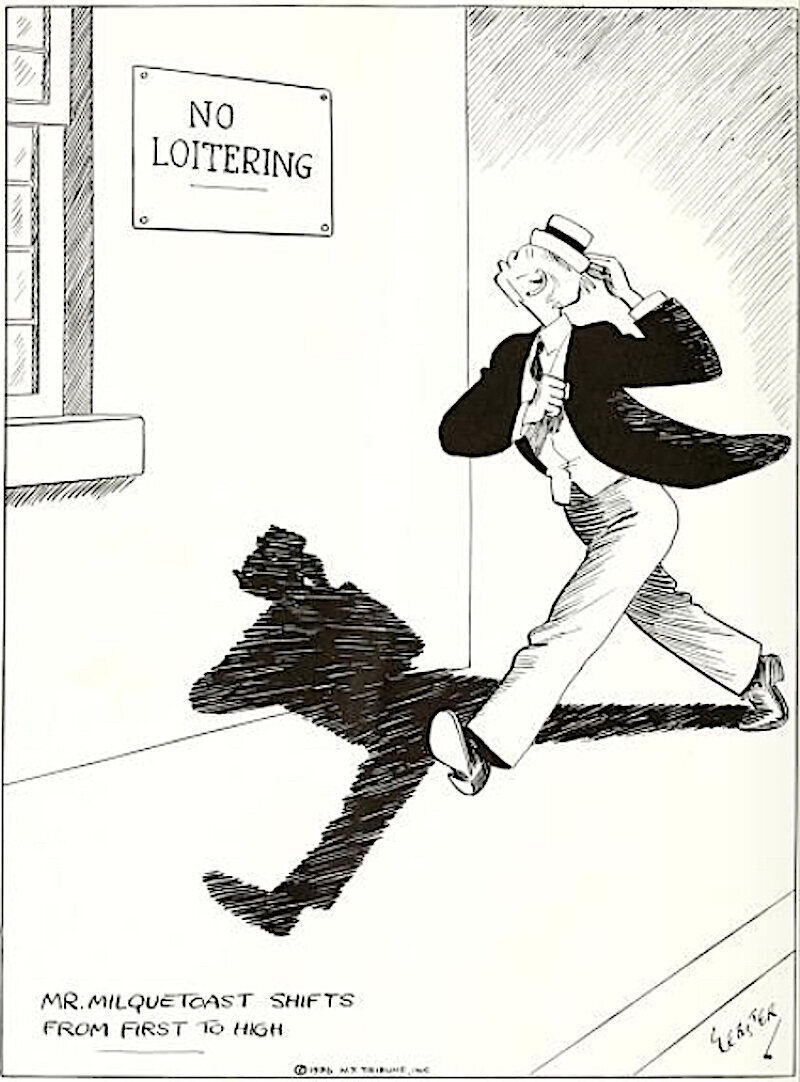
caspar milquetoastHello, 2026 Spring Semester. I’m not teaching this term, as I edit an anthology of essays about AI’s impact upon writing classrooms, programs, and centers. It will certainly generate more words for this blog.

Meanwhile, let’s look at a term that I use a bit, but whose origin came from before my time. I didn’t know the etymology until ran across a reference in David Michaelis’ outstanding biography of Charles M. Schulz, Schulz and Peanuts. The famous cartoonist’s career briefly overlapped that of H.T. Webster’s The Timid Soul, a strip that gave the world a meek protagonist, Caspar Milquetoast. When Charlie Brown is at his Charlie-Browniest, there’s a bit of Caspar in his humiliation. You can read more about Webster’s comic series here.

For several decades, timid people were called milquetoasts, after Casper.

The character’s name comes from milk-toast, a dish we don’t see much these days. It’s a bland concoction of toasted bread soaked in milk, perhaps sweetened or seasoned mildly. More for you! Having just made some spoonbread, which I do find wonderful, that’s as bland and inoffensive as I need while I still have teeth in my skull.

We no longer frequently hear this week’s word, one that qualifies as a neologism or newly coined word, alas. “Wimp” has taken its place. The OED has two instances of it being spelled “milktoast” with the same meaning. Unusually for that dictionary, I couldn’t find a frequency-of-use chart; it’s hiding behind a tree somewhere, like Mister Milquetoast.

Pop-culture icons come and go, but sometimes they leave us a word. I covered googly eyes here some time ago; cartoon character Barney Google gave us that one. I do wonder what linguistic influences Peanuts will leave us in a few decades? I do sometime see damaged or deformed Christmas trees marked as “Charlie Browns” at reduced prices.

Please do not be a milquetoast or a Charlie Brown. Put your googly eyes to work and send words and metaphors my way by e-mailing me (jessid -at- richmond -dot- edu) or leaving a comment below. Want to write a guest entry? Let me know!

See all of our Metaphors of the Month here and Words of the Week here.

Image: Caspar M tries not to give offense, even to a sign on the wall.