THE MOST INTERESTING BLOG EVER-PLEASE COMMENT!

About Project Noah: http://www.projectnoah.org/about

I came across the website through an advertisement on the National Geographic Website. Clicking on the link soon lead me to an interesting project that four NYU graduates have created. Entitled “Project Noah”, the experiment attempts to build a fun, location-based database mapping out wild-life intercations all around the world. The way Project Noah works is that anywhere at anytime, if you come across an organism, you take a picture of it, post it on the website, and attribute a location to where you spotted it. Oftentimes, members do not know the “official” names of the organisms that they take pictures of- but that is where the social networking aspect of Project Noah comes in. On the website, you can post and comment on the pictures by writing the name of the organism or general feelings toward the picture.

Another aspect of Project Noah is that it conveys the vast biodiversity around the world. With over 120,000 participants, and over millions of pictures uploaded, Project Noah serves as a catalog for speicies diversity and dispersion. Members can also participate in “missions”, which link all the classified organism pictures into a central location such as the National Saguaro Park. This helps scientists count and identify the certain species in the Park.

Project noah’s most notable feature is that it can be downloaded as an app, so pictures and categroizations can be uploaded easily and at any time. I see this whole project as a way to encourage people to reconnect with nature, documenting local wildlife, and creating “citizen-scientists”.

Banff Wildlife Crossings Project

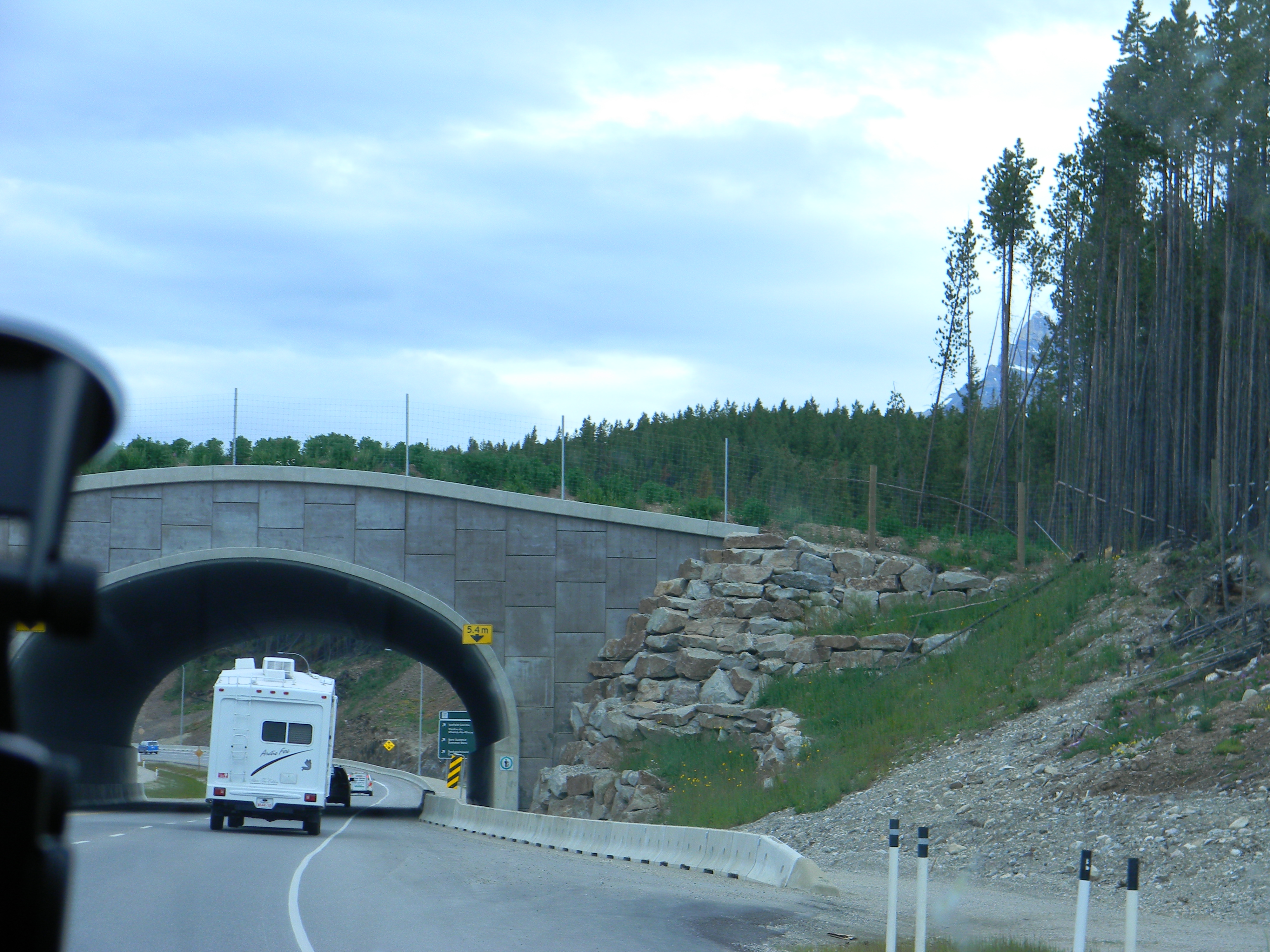
This summer I visited Banff National Park in Alberta, Canada and we spent a lot of time driving on the Trans-Canada Highway. All along the TCH in Banff National Park, there are wildlife overpasses and underpasses that allow wildlife to safely cross the road without risking collision with vehicles on the road. I took a picture of one of the two overpasses currently in the park (it’s a little blurry). Having learned about habitat fragmentation and the importance of corridors in other classes, I decided to look more into this specific case.

The purpose of wildlife underpasses and overpasses is not only to protect the animals from the immediate risk of road mortality caused by park infrastructure, but also to help maintain a stable and diverse wildlife population. Because the Trans-Canada Highway is so large and heavily used, it has become a huge barrier for wildlife, which restricts their movement and habitat area, and eventually leads to a less diverse population because they are confined to a smaller habitat patch, and eventually can lead to extinction. Road mortality can also have an effect on a species’ population in a shorter amount of time (1-2 generations) than edge effects caused by the road. The project created is called The Banff Wildlife Crossings Project and was started in 1996.

In Banff National Park, they have created various measures of wildlife crossing structures in order to attempt to solve this problem. There are two wildlife overpasses that span 50-m wide over the highway. They monitored the effects of these wildlife over and underpasses for five years. From this they discovered that they have reduced all road-kill by 80%. As to determine the effect of the over and underpasses on reducing habitat fragmentation, a longer-term study is needed. However, overall the project has been a success.


Chesapeake Bay Shows Signs of Improving Health

Link: http://www.ens-newswire.com/ens/nov2011/2011-11-03-093.html

According to research being performed by scientists at Johns Hopkins University and the University of Maryland Center for Environmental Science, the efforts to clean up the Chesapeake Bay are proving successful.  Water samples compared to those over the last several decades show that the nation’s largest estuary is getting healthier in a sense.

This has come about as a result of reduction of the flow of fertilizers, waste, and other pollutants, which has in turn reduced the overall size of the oxygen-starved dead zones (uninhabitable areas for plants and animals) in the body of water.  Rebecca Murphy, who is part of the Department of Geography and Environmental Engineering at Johns Hopkins, believes that there is a direct correlation between the two occurrences, which seems a good sign for the future of the Chesapeake Bay and other vital water bodies.

The effort to clean up the bay really took hold in the 1980s with the federal Chesapeake Bay Program, which focused on restoring the previous condition of the water.  While this past year did not present the  best data regarding shrinking volume of dead zones, the overall trend in recent years has been positive in that these oxygen deprived areas have been decreasing.  Some scientists were concerned as there have been reports of early summer jumps in dead zone activity, but this has been shown to be a result of climate forces such as heavy rains, wind, salinity, and the sea level of the water.  If not for the efforts to decrease the flow of the contaminants into the Chesapeake Bay, the prevalence of the oxygen starved zones would surely have been worse.

IN SUMMARY: While overall climate change has been having negative effects on the Chesapeake Bay, localized monitoring and pollutant reduction has lessened the issues. Hooray for a positive (or at least less negative) development!


Sunspots, Active Region 1339

By: Shane Sullivan

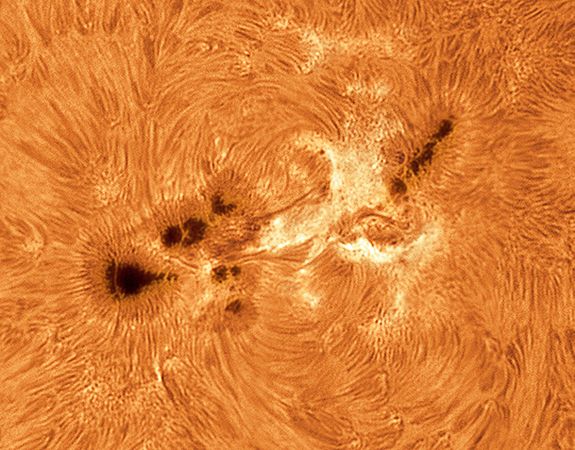
Sunspots are magnetic storms on the surface of the Sun which are sometimes visible from Earth as black dots on the surface of the Sun. Recently scientists observed the largest group of sunspots seen since 2005 which collectively are “approximately 17 times the width of our planet”. This group of spots has been named active region (AR) 1339 and is of particular interest to scientists because of its current orientation in relation to the Earth.

“A picture of the sunspot cluster known as AR 1339 taken with a backyard telescope”

AR 1339 is now located in the center of the Sun directly pointing towards Earth which has the potential to cause damages to satellites and humans if solar flares become active. Although, the last solar flare activity recorded from AR 1339 was on the 3rd of November flares can become active anytime and are at most detectable within minutes of the occurrence. These flares have a high potential to disrupt satellites and due to radiation exposure pose health risks to airline pilots and scientists aboard the space station.

While AR 1339 is visible to the naked eye Philip H. Scherrer, a Stanford professor, warns, like Tiho, that “people should never look directly at the sun”.

http://news.nationalgeographic.com/news/2011/11/111110-sunspots-ar1339-earth-jupiter-solar-flare-auroras-space-science/

Snowtober 2011 in the Northeast

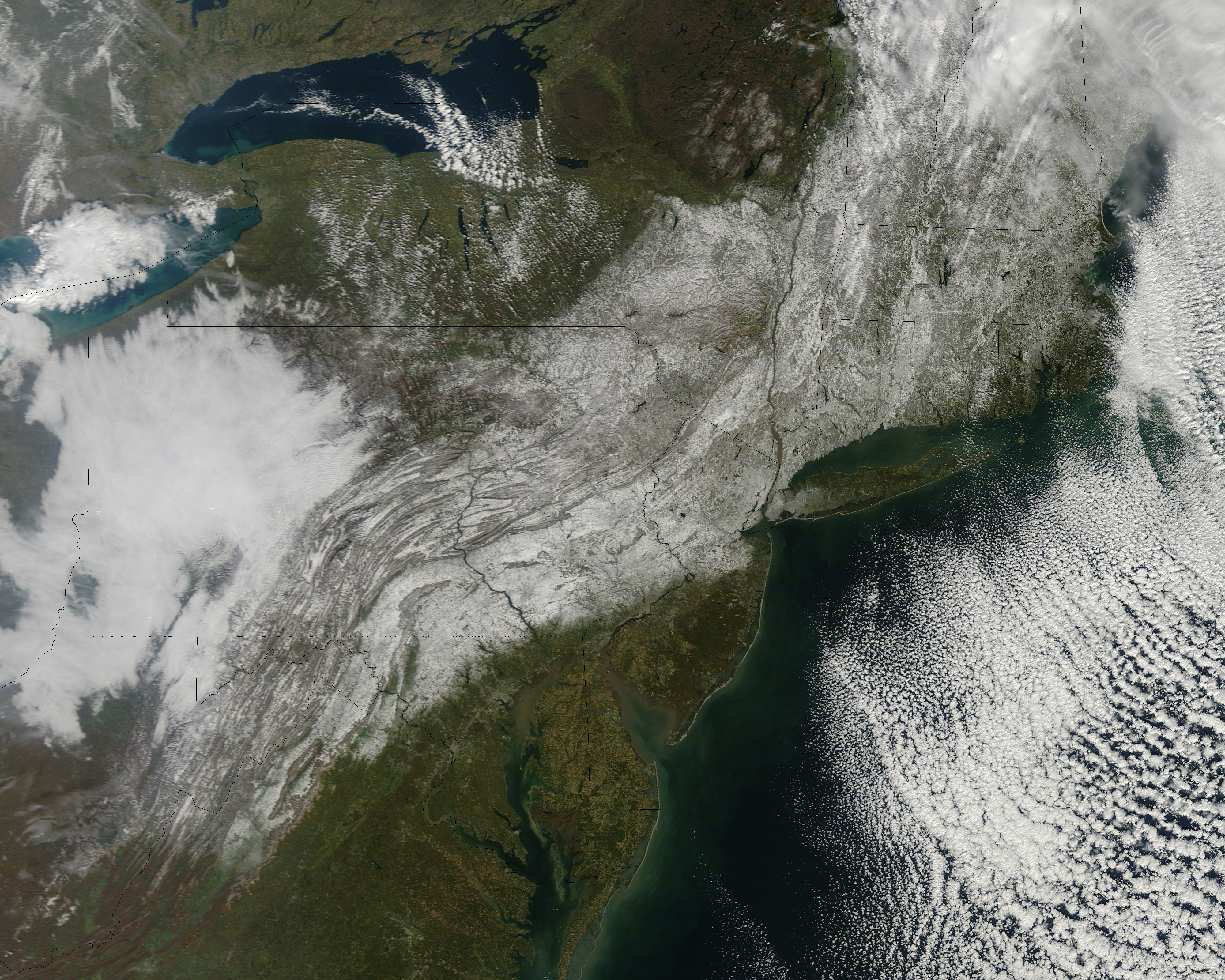
The North East and Mid-Atlantic region of the United States (from West Virginia to Maine) experienced an unseasonably early snow storm on the weekend of Halloween, October 29-30, 2011. The nor’easter brought as much as 81 inches of snow in some places and the weight of the snow on the still-attached leaves, made branches to snap more easily. The snapping of trees led to many downed power lines and a chaotic attempts by utilities personnel to restore power. Over 3 million homes lost power during this time, exceeding the number of power outages experienced in September 2011’s Hurricane Irene.

Central Park in New York City broke records – it was the only time in its history that snow accumulation exceeded 1-2 inches within the month of October. By the first morning of the storm on Saturday, October 29, 2011, Central Park had already received 2.9 inches of snow.  The storm also brought New York City closer to the “all-time wettest” year in its history,  In total, the storm gave New York City 65.75 inches of precipitation – over 2 feet above average! In New Hampshire and Massachusetts, 31.4 inches and 32 inches of snow were produced, also above average during the month of October. According to NOAA, the Northeast had 86% snow cover with approximately 4” deep. Very, very unusual.

http://earthobservatory.nasa.gov/IOTD/view.php?id=76267

NASA's "Image of The Day" during Snowtober 2011

One weather historian Christopher Burton has called the storm, “the most extraordinary October snowstorm in over two centuries in the northeastern US”. This unseasonable snowstorm is further proof of a warming world. With warmer temperatures, the atmosphere is able to hold more moisture and thus heavier precipitation. With temperatures falling just below freezing during late October 2011, this precipitation came down as snowfall.


Freedman, A. (2011, October 31). Historic October Northeast storm: Epic. Incredible. Downright ridiculous. Capital Weather Gang. The Washington Post. Accessed November 5, 2011