All posts by Scott Allison

About Scott Allison

Scott Allison has authored numerous books, including 'Heroes' and 'Heroic Leadership'. He is Professor of Psychology at the University of Richmond where he has published extensively on heroism and leadership. His other books include Reel Heroes, Conceptions of Leadership, Frontiers in Spiritual Leadership, and the Handbook of Heroism. His work has appeared in USA Today, National Public Radio, the New York Times, the Los Angeles Times, Slate Magazine, MSNBC, CBS, Psychology Today, and the Christian Science Monitor. He has received Richmond's Distinguished Educator Award and the Virginia Council of Higher Education's Outstanding Faculty Award.

The Heroism of Daryl Davis, Collector of Robes

3258E1E800000578-3499658-image-m-11_1458344520932By Rick Hutchins

To those who took part in the social revolution of nearly half a century ago, the 21st century was expected to be a time of Utopian ideals. Instead, the world has entered a Dark Age of growing extremism, in which hate-mongering and race-baiting have replaced efforts to promote positive change. Instead of leaving the world a better place than they found it, the aging architects of that revolution have had to watch their accomplishments undermined and eroded.

This has led to an atmosphere of despair. Many wonder how we can come back from a culture war in which every day brings escalated rhetoric and the threat of increasing violence.

The answer, of course, is the same as it has always been. The only way to win a war of ideas is to win the hearts and minds of the people. And the only way to truly win hearts and minds is to be right.

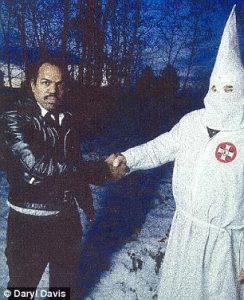
For several decades now, a man named Daryl Davis has been doing just that, in a manner that is as unlikely as it is courageous. Davis, who holds a 3258E1BE00000578-3499658-image-a-20_1458344683084bachelor’s degree in music and who has performed with artists such as Chuck Berry and Jerry Lee Lewis (to say nothing of his own band), is a Black man who was a child during the Civil Rights Era. He experienced firsthand the harsh reality of that struggle when he became the first Black member of a local Cub Scout troop in Massachusetts. But his innate intellectual curiosity combined with his benevolent disposition to form a most unique reaction to the problem of racism.
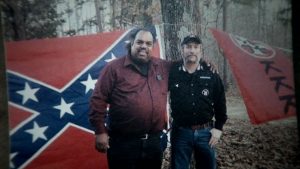
It was in 1983 that Davis met a member of the Ku Klux Klan for the first time, in a bar in Maryland where Davis was performing. This proved to be an educational experience for both men. For the Klansman, because he had never known a Black man before and so was suddenly seeing one as a human being. And for Davis because he finally found the answer to the question of how someone could hate him without knowing him — it was because they didn’t know him.

The friendship that resulted from this encounter not only turned this Klansman away from the Klan, but showed Daryl Davis his path forward.

Over the course of the years that followed, demonstrating patience and tolerance that can only be described as superhuman, Davis met many more Klansmen, by arranging introductions, setting up interviews, and even getting himself invited to Klan meetings. He believed that most racists hold their beliefs because of misconceptions instilled in them in their childhoods, and that it is difficult to maintain these prejudices when confronted with an actual person who belies them.

In short, he believed that the cure for ignorance is education, that the cure for suspicion is kindness, and that the cure for hatred is friendship. In this, he has been proven correct many times over.

accidental-courtesy-daryl-davis-klansmanDavis is currently in possession of more than two dozen KKK robes, given to him by former Klansman who have abandoned their ideology, disarmed by the mere existence of this good-natured peacemaker. Among those who have foresworn White supremacy in favor of a Black friend is Roger Kelly, former Imperial Wizard of the Maryland KKK. Kelly later invited Davis to be his daughter’s godfather.
Unbelievably, or perhaps not given the current political climate, Davis has been on the receiving end of criticism from some who self-identify as Progressives, including some members of Black Lives Matter and the NAACP. He has been called an Uncle Tom, and worse, and his achievements have been minimized and trivialized. After all, say his detractors, what difference does it make that in thirty years one man has softened only a smattering of hearts, has changed only a handful of minds?

But what if everyone was like Daryl Davis?

– – – – – – – – – –

Rick Hutchins was born in Boston, MA, and has been an avid admirer of heroism since the groovy 60s. In his quest to live up to the heroic ideal of helping people, he has worked in the health care field for the past twenty-five years, in various capacities. He is also the author of Large In Time, a collection of poetry, The RH Factor, a collection of short stories, and is the creator of Trunkards. Links to galleries of his art, photography and animation can be found on http://www.RJDiogenes.com.

Hutchins is a regular contributor to this blog.  Two of his published essays, on astronaut and scientist Mae Jemison and the Fantastic Four’s Reed Richards, can be found in our book Heroic Leadership.

© 2017 Rick Hutchins

Heroes of Richmond: Four Centuries of Courage, Dignity, and Virtue

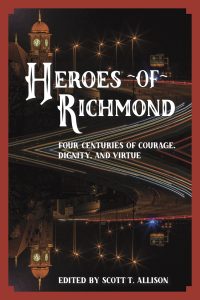
Heroes of Richmond CoverIt has been hailed as a gorgeous river city blessed with abundant resources. It has also been called the city of “contradictions” and “crises” (Campbell, 2012), a city with a “complicated history” replete with “struggles and wounds” (Ayers, 2012; Schwartz, 2012). Richmond, Virginia, has been a magnet for heroism and villainy, a place where the best and worst of human nature have collided over several centuries.
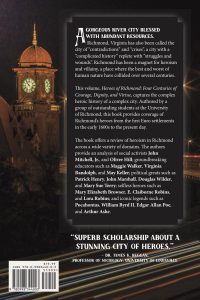
This volume, Heroes of Richmond: Four Centuries of Courage, Dignity, and Virtue, represents an attempt to capture the complex heroic history of a complex city. Authored by a group of outstanding students at the University of Richmond, this book provides coverage of Richmond’s heroes from the first European settlements in the early 1600s to the present day.

Heroes of Richmond is now available for purchase right here.

The book offers a review of heroism in Richmond across a wide variety of domains. The authors provide an analysis of social activists John Mitchell, Jr., and Oliver Hill; groundbreaking educators such as Maggie Walker, Virginia Randolph, and May Keller; political greats such as Patrick Henry, John Marshall, Douglas Wilder, and Mary Sue Terry; selfless heroes such as Mary Elizabeth Browser, E. Claiborne Robins, Lora Robins, and several unsung citizens; and iconic legends such as Pocahontas, William Byrd II, Edgar Allan Poe, and Arthur Ashe.

“Superb scholarship about a stunning city of heroes.” – Dr. James K. Beggan, Professor of Sociology, University of Louisville

– – – – – – – – – –

Table of Contents:

Heroes of Richmond: Four Centuries of Courage, Dignity, and Virtue

Edited by Scott T. Allison

Foreword
Mary Kelly Tate, University of Richmond

Introduction

Richmond, Virginia: A Cultural and Historical Nexus of Heroism
Scott T. Allison, University of Richmond

Part 1
Iconic Heroes

Chapter 1. The Founding of Richmond: William Byrd II’s Heroic Odyssey
Jonathan Anthony Ohlmann, University of Richmond

Chapter 2. Pocahontas: The Unknown, Underestimated Hero of Central Virginia
Meghan N. Dillon, University of Richmond

Chapter 3. The Tell-Tale Hero: Edgar Allan Poe
Michael David Bonifonte, University of Richmond

Chapter 4. Arthur Ashe: A Hero On and Off the Court
Carlie Q. Blessing, University of Richmond

Part 2
Activist Heroes

Chapter 5. John Mitchell Jr: The Hero of Richmond Journalism and Social Change
Josh A. Trauberman, University of Richmond

Chapter 6. Waging War on Separate vs. Equal: Oliver Hill’s Journey From Small Town to the Highest Court
Kathryn K. Lynch, University of Richmond

Part 3
Educator Heroes

Chapter 7. Maggie Lena Walker: The Hero of the Harlem of the South
Brendan J. Griswold, University of Richmond

Chapter 8. Virginia E. Randolph: A Hero of African American Schooling in Virginia
Declan J. Horrigan, University of Richmond

Chapter 9. May Lansfield Keller: The Hero Who Defied All Odds
Aliya J Sultan, University of Richmond

Part 4
Political Heroes

Chapter 10. Patrick Henry: The Revolutionary Hero
Bailey A. Gillespy, University of Richmond

Chapter 11. John Marshall: The Supreme Hero of Justice
Emmalyn G. Dressel, University of Richmond

Chapter 12. Lawrence Douglas Wilder: The Black Pioneer
Janell M. Spigner, University of Richmond

Chapter 13. Mary Sue Terry: The Hero Who Defied the Double Bind
Thomas J. Villani, University of Richmond

Part 5
Selfless Heroes

Chapter 14. Mary Elizabeth Bowser: The Game-Changing Hero
Morgan E. Caron, University of Richmond

Chapter 15. E. Claiborne and Lora Robins: The Convergence of Two Selfless Heroes
Lauren J. Weingarten, University of Richmond

Chapter 16. Unsung Heroes of Richmond: The Extraordinary Feats of Elizabeth Van Lew, Gilbert Hunt, and Sally Tompkins
Mikaela R. Rosen, University of Richmond


Bibliography

Campbell, B. (2012). Richmond’s unhealed history. Richmond: Brandylane Publishers.

Griggs, W. S. (2012). Hidden history of Richmond. Charleston, SC: The History Press.

Williams, D. (2015). Spending two perfect days in Richmond, Virginia. http://www.forbes.com/sites/forbestravelguide/2015/04/08/spending-two-perfect-days-in-richmond-virginia/#7b19496066af

Heroes of Richmond Cover

Heroes of Richmond Cover

Are Men More Likely Than Women to Become Heroes and Villains?

By Scott T. Allison and George R. Goethals

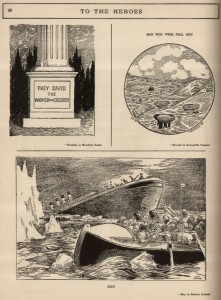
The world recently observed the 100th anniversary of the Titanic disaster in which 1,514 people died after the ship struck an iceberg.  Much has been said about the “women and children first” rule that determined who would be the lucky ones to board the limited number of lifeboats.  Editorial cartoons of the day honored the heroic men who sacrificed their lives to allow others to live.  While gender roles have certainly changed since 1912, studies show that there is still considerable pressure on males to protect women from danger and to place their own well-being behind that of women.

Psychologist Roy Baumeister at Florida State University thinks he knows why men seem so self-sacrificing.  In nearly all human societies “men are expendable,” he proclaims.  And with expendability comes the kind of heroism shown by the men of the Titanic who drowned so that others would live.

Understanding Baumeister’s argument requires an examination of his larger thesis, namely, that evolution has endowed men and women with different motivations and priorities.  In his recent book, Is There Anything Good About Men, Baumeister first examines our patriarchal society — the inescapable fact that men have long dominated the political and economic spheres of our culture.  Men are more likely than women to be presidents, prime ministers, and members of Congress and Parliament.  Men are also more likely to be CEOs of major corporations and wielders of power on Wall Street.  We also see more men discovering cures for diseases, exploring space, and creating great works of art.

Feminists have argued that this gender gap in power, success, and wealth is due to men’s deliberate attempt to oppress women.  Baumeister does not disagree with this assertion.  He does, however, challenge us to understand culture (e.g., a country, a religion) as an abstract system that competes against rival systems and that uses both men and women, often in different ways, to advance its cause.

Baumeister’s first observation is that while there are no doubt more men than women at the top of society, there are also more men at the bottom.  Men are far more likely than women to commit crimes and to serve time in prison.  Men are also more likely to suffer from severe mental disabilities; they are more likely to die in wars; they are more likely to be homeless; and they are more likely to have the worst and most dangerous jobs in society.

In short, Baumeister argues that men go to extremes more than women.  “In an important sense,” he writes, “men really are better AND worse than women.”

Why is this the case?  Baumeister points to biology and evolution.  Recent research using DNA analysis reveals that today’s human population is descended from twice as many women as men.  Throughout all of human history, it is estimated that perhaps about 80% of women but only 40% of men have been able to reproduce.  “It would be shocking,” writes Baumeister, “if these vastly different reproductive odds for men and women failed to produce some personality differences.”

Because men have faced a more daunting challenge in reproducing, they may have evolved to be more risk-taking than women.  Nature may have designed men to take chances, try new things, be creative, and explore bold possibilities.  Becoming a hero who succeeded in these risky endeavors may have given men a better chance to attract a woman with whom to reproduce.

Baumeister believes that because women are able only to bear a few children in their lifetime, their priority is to “play it safe” and invest time in developing close intimate relationships.  Women have done best by minimizing risks.

The key to understanding why women have evolved to avoid physical risk lies in understanding what drives population growth.  Baumeister argues that population growth depends much more upon there being plenty of women than upon there being plenty of men.  “To maximize reproduction,” says Baumeister, “a culture needs all the wombs it can get, but only a few penises can do the job.”  If a society loses half its men, the next generation can still be full-sized.  But if it loses half its women, the size of the next generation will be significantly smaller.  As a result, most cultures keep their women out of harm’s way while using men to do the risky work.

In short, men were designed by nature to take chances, risk their lives, and strive — mostly unsuccessfully — for greatness.

According to Baumeister, the emergence of gender inequality may have little to do with men pushing women down in a patriarchal conspiracy.  Rather, it came from naturally evolving forces that drove expendable men to seek out wealth, knowledge, and power at great risk to themselves and with the goal of improving their reproductive chances.

This brings us back to the Titanic and the men who heroically died so that women and children would live.  While nature may have designed men for this type of bold heroic sacrifice, this same brazenness sends many men spiraling downward toward a life of crime and other villainous activities.  Men are thus hard-wired for both greatness and wretchedness.  It’s a provocative idea, and it’s not without its detractors.  But it is also an idea well-worth thinking about.

References

Allison, S. T., & Goethals, G. R. (2011). Heroes: What They Do & Why We Need Them.  New York: Oxford University Press.

Baumeister, R. (2010). Is There Anything Good About Men?: How Cultures Flourish by Exploiting Men. New York: Oxford University Press.

The Resurrection of Christ is the Hero’s Transformation

Resurrection1By Scott T. Allison

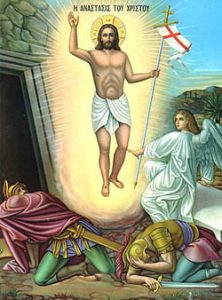
Every Easter season, about three billion Christians around the world celebrate the resurrection of Jesus. In an earlier blog post, we discussed the heroism of Jesus and the significance of his life, death, and resurrection. For Christians, resurrection signifies the immense power of God, and it validates who Jesus claimed to be, namely, the son of God.

But there is more.

According to many scholars, including Joseph Campbell and Richard Rohr, the rise, suffering and resurrection of Jesus are all significant because they model the human journey of growth, setback, and heroic transformation. I use the word “model” deliberately. We’re all destined to rise, fall, and become resurrected. Jesus showed us that our lives are all about — or should be about — transformation.

The life of Jesus is a blueprint for all human life. You don’t have to be a Christian to appreciate the significance of Jesus’ life and death.

For now, let’s focus on transformation, which I believe is the centerpiece of the hero’s journey. All good heroes in storytelling undergo a transformation that forever changes them morally, emotionally, mentally, physically, and/or spiritually. My friend and colleague Greg Smith and I talk about the significance of these types of transformations in our 2015 book, Reel Heroes & Villains.

There is no more dramatic transformation than campbell_herothe one undergone by Jesus of Nazareth. His life followed the classic pattern in hero storytelling. Denied proper shelter and born in a manger, Jesus overcame poverty to grow into the wisest spiritual leader of his time – a remarkable transformation. This transformative rise of the hero represents the first part of the heroic arc.
As with all heroes, his ascendancy had to come to an end. Jesus was arrested for threatening the established order, and he was tortured and brutally murdered. This tragic fall of the hero is part two of the classic heroic arc.

The third act in the heroic journey is the hero’s rising from the ashes of defeat. As Joseph Campbell wrote, “The crucifixion is not a calamity if it leads to new life.” The resurrection was a dramatic physical and spiritual transformation that not only represented the transcendence of Jesus – it transformed all of Western civilization for two millennia and beyond.

More from Campbell: “Through Christ’s crucifixion we were unshelled, which enabled us to Falling-Upwardbe born to resurrection. The imitation of Christ, then, is participating in the suffering and joys of the world, all the while seeing through them the radiance of the divine presence.”

And from Richard Rohr: “Jesus is actually naming and revealing what is happening everywhere and all the time in God. Jesus’ resurrection is a statement about how reality works: always moving toward resurrection.”

Resurrection, then, is transcendence. For Christians, it can also be likened to other phenomena of spiritual change, including conversion and salvation. Hindus call dramatic growth of this type enlightenment, and Buddhists call it bodhicitta. Twelve step programs call it an awakening. The Greeks called it metamorphosis. Psychologists like myself label it plain old development.

But development is clearly an understatement. Transformation is a complete change in form, not unlike a caterpillar transforming intometamorphosis a butterfly. The resurrection of Jesus is the most dramatic form of transformation possible, at personal level and at the level of an entire society or culture.



The pattern in Jesus’ life, and in our own lives, is clear. We move from order to disorder to reorder. And psychologists who study post-traumatic growth will tell you that the final reorder is a more beautiful place to be than the original order.

Transformation gives us hope that no matter how dire our circumstances, we can be redeemed. Hero stories move us all because they call us all. This Easter season, we can pay attention to the story of resurrection and thereby learn much about the hero’s journey that awaits each of us.

– – – – – – – – – – – – – – – – – – –

Bibliography

Allison, Scott, and Goethals, George. (2017). The hero’s transformation.

Allison, Scott, and Smith, Greg. (2015). Reel Heroes & Villains.

Campbell, Joseph. (1995). Reflections on the Art of Living.

Rohr, Richard. (2011). Falling Upward.

Heroism as an Emergent Property

© 2013 Rick Hutchins

It seems like it should be very simple-– the definition of heroism. And yet, as we’ve seen, any attempts to delineate a definitive set of properties or criteria result in debate, disagreement and dissatisfaction. The more we try to pin down the concept, the more amorphous it seems. This is because heroism is not an intrinsic property, but an emergent one. In the words of the great philosopher Anonymous, “Heroes are made, not born.”

This is not to say that the potential for heroism does not exist in everyone, but acts of heroism are decidedly situational. The woman who saved her platoon in Afghanistan may be useless when her neighbor’s cat is stuck up a tree –- she’s afraid of heights. Or the man who quietly devoted ten years of his life to caring for his sick mother may not be the person you want around if you’re drowning –- he never learned to swim. The scientist whose vaccine saved countless lives may lack the upper body strength to pull an unconscious adult from a burning building. The great orator whose speeches inspired millions may lack the esoteric knowledge needed to assist somebody having an epileptic seizure.

However, on another day, an undistinguished man with a questionable past may be sitting on his front porch, hear a cry for help, and find himself rescuing several kidnapped women from their captor. Or perhaps a woman who was previously known only as a baseball player’s daughter may be walking down the street, minding her own business, and find herself catching a one-year-old baby who fell from a fire escape. Or perhaps a middle-aged construction worker, waiting for a train with his two kids, will find himself saving the life of a seizure-stricken stranger who fell upon the tracks. Or perhaps a shopper at the supermarket, thinking only of taking home some groceries, may find himself performing CPR on the still body of a child, bringing her back to life.

Ordinary people, ordinary days, ordinary circumstances that suddenly blossom into extraordinary events. What seems inevitable is averted. Like life itself, heroism is a thing of self-organizing complexity, emergent, synergistic-– an antidote to entropy.

It is inevitable that we should seek to understand the existence and nature of heroism. Seeking to understand is one of the essential qualities of humanity and we are rightfully amazed at a universe that can give rise to beings who can conceive of such a sublime, but slippery, idea. Yet we also must realize that concepts in the abstract have no perfect analogs in the physical world. The zen concept of a chair is perfect to the intellect, but only infinite imperfect variations exist in reality. We can calculate the mathematical properties of a perfect circle, but no such thing exists outside the realm of pure thought. When the abstract is made real, it is unique and unprecedented-– it is emergent-– and, while it may have aspects in common with past examples, attempting to formalize the concept in absolute terms is like trying to psychoanalyze a person not yet born.

Perhaps, then, the best way to define heroism is to understand that heroism defines itself.

– – – – – – – – – – –

Rick Hutchins was born in Boston, MA, and is a regular contributor to this blog.  In his quest to live up to the heroic ideal of helping people, he has worked in the health care field for the past twenty-five years, in various capacities. He is also the author of Large In Time, a collection of poetry, The RH Factor, a collection of short stories, and is the creator of Trunkards. Links to galleries of his art, photography and animation can be found on http://www.RJDiogenes.com.

Two of Hutchins’ previous essays on heroes appear in our book Heroic Leadership: An Influence Taxonomy of 100 Exceptional Individuals.

– – – – – – – – – – – – – – – – – – – – – – – – – – – – – – – – – – – – – – – – – – – – –

Handbook of Heroism and Heroic Leadership

HeroismHandbookCoversThe Handbook of Heroism and Heroic Leadership represents the first effort to gather scholarship on heroism into one definitive reference volume.

The Handbook showcases scholarly contributions from distinguished social scientists on the topics of leadership, morality, resilience, courage, empathy, meaning, purpose, altruism, hope, human growth, cooperation, spirituality, health, transformation, and character strengths. The volume provides a much-needed consolidation and synthesis for scholars of heroism and heroic leadership.

The Handbook of Heroism and Heroic Leadership features three conceptually distinct sections that reflect the current state of theory and research on heroism and heroic leadership. These sections are Origins of Heroism, Types of Heroism, and Processes of Heroism. The Origins of Heroism section focuses on the formation, causes, and antecedents of heroic action. Types of Heroism addresses phenomena associated with different categories of heroism and how these hero types affect individuals and society. Processes of Heroism examines the functions, processes, and consequences of heroism.

This volume offers insights and inspiration about the pinnacle of human behavior and how leaders can make use of these insights to help their followers reach their fullest potential. The Handbook provides a compelling foundation for the development of a multidisciplinary perspective on the antecedents and consequences of heroic behavior. The Handbook of Heroism and Heroic Leadership shines a scholarly light on all the gifted and enlightened leaders whose behavior has embodied the most exquisite qualities of humanity.

The Handbook is published by Routledge and is now available at Amazon.com.

Table of Contents

Foreword

Philip Zimbardo

Introduction

Setting the Scene: The Rise and Coalescence of Heroism Science

Scott T. Allison, George R. Goethals, and Roderick M. Kramer

Part I

Origins of Heroism

  1. Attributes and Applications of Heroes: A Brief History of Lay and Academic Perspectives

Elaine L. Kinsella, Timothy D. Ritchie, and Eric R. Igou

  1. Why Heroism Exists: Evolutionary Perspectives on Extreme Helping

Sara Kafashan, Adam Sparks, Amanda Rotella, and Pat Barclay

  1. Adaptive Foundations of Heroism: Social Heuristics Push Advantageous Everyday Ethical Behaviors to Heroic Extremes

Gordon T. Kraft-Todd and David G. Rand

  1. The Evolution and Neurobiology of Heroism

Stephanie D. Preston

  1. Character Development and the Emergence of Heroic Leadership: Towards a Relational Developmental Systems-Based Model

Kristina Schmid Callina, Richard M. Lerner, Ettya Fremont, Brian Burkhard, Danielle Stacey, and Shaobing Su

  1. The Moral Character of Heroes

Lawrence J. Walker

  1. Why and How Groups Create Moral Heroes

Ari Decter-Frain, Ruth Vanstone, and Jeremy A. Frimer

  1. The Hero Organism: Advancing the Embodiment of Heroism Thesis in the 21st Century

Olivia Efthimiou

Part II

Types of Heroism

  1. Everyday Heroes: Determinants of Moral Courage

Anna Halmburger, Anna Baumert, and Manfred Schmitt

  1. Heroism in Times of Crisis: Understanding Leadership During Extreme Events

Zeno E. Franco

  1. Holocaust Heroes: Heroic Altruism of non-Jewish Moral Exemplars in Nazi Europe

Stephanie Fagin-Jones

  1. Heroism and Wisdom in Medicine

Margaret Plews-Ogan, Justine E. Owens, Natalie May, and Monika Ardelt

  1. Deviant Heroes and Social Heroism in Everyday Life: Activists and Artists

Mihaly Csikszentmihalyi, Michael Condren, and Izabela Lebuda

  1. To Become or Not to Become? Existential Courage and the Pursuit of Desired Identities

Roderick M. Kramer

  1. Heroism in the Networked Society

Dana Klisanin

  1. A Training Program in Spiritually-Oriented Leadership: Inner Growth for Outer Change

Elsa Lau, Sarah B. Sherman, and Lisa Miller

  1. Career Development and a Sense of Calling: Contexts for Heroism

Bryan J. Dik, Adelyn B. Shimizu, and William O’Connor

  1. Underdogs as Heroes

Joseph A. Vandello, Nadav Goldschmied, and Kenneth Michniewicz

  1. Whistleblowers as Heroes: Fostering ‘Quiet’ Heroism in Place of the Heroic Whistleblower Stereotype
    A J Brown

Part III

Processes of Heroism

  1. The Hero’s Transformation

Scott T. Allison and George R. Goethals

  1. Moral Transformation: The Paths to Heroism, Villainy and Victimhood

Amelia Goranson and Kurt Gray

  1. The Impact of Heroism on Heroes and Observers: Stories of Elevation and Personal Change

Jeanne Nakamura and Laura Graham

  1. Accidental and Purposeful Impediments to Heroism

Craig D. Parks

  1. Heroic Empathy: The Heart of Leadership

Ronald H. Humphrey and Laural L. Adams

  1. Heroic Leaders and Despotic Tyrants: How Power and Status Shape Leadership

Anika Stuppy and Nicole L. Mead

  1. The Intersection of Purpose and Heroism: A Study of Exemplars

Kendall Cotton Bronk and Brian R. Riches

  1. Heroism and the Pursuit of Meaning

Jeffrey D. Green, Daryl R. Van Tongeren, Athena H. Cairo, and Nao Hagiwara

  1. Psychopathy and Heroism: Unresolved Questions and Future Directions

Brett A. Murphy, Scott O. Lilienfeld, and Ashley L. Watts

  1. The Courage of One’s Moral Convictions: Exploring the Two Sides of Heroism

Ronnie Janoff-Bulman and Prerana Bharadwaj


Here’s what they’re saying about the Handbook of Heroism and Heroic Leadership:

“Editors Scott Allison, George Goethals and Roderick Kramer have assembled an outstanding team of contributors whose expertise ranges from neurobiology and evolutionary psychology to developmental approaches as well as spirituality, leadership, and career development. In addition to the variety of topics and approaches featured in this volume, readers will appreciate the uniform clarity of the presentations and their engaging style of academic storytelling.”

  • Phil Zimbardo, Professor Emeritus, Stanford University, and Founder of the Heroic Imagination Project

“The study of heroes and exemplars is generating increasing excitement throughout the social sciences at the present time, and for good reason. We live in a time of diminished expectations for moral leadership and true heroism. This innovative Handbook of Heroism and Heroic Leadership draws on the best available science to help us understand the conditions that foster heroic leadership, and how it works across a variety of social contexts. The volume is an essential contribution to the study of human lives in all their full potential.”

  • William Damon, Professor and Director, Stanford Center on Adolescence, author of The Path to Purpose

“Studying heroism is challenging for scientists, yet Allison, Goethals, and Kramer have assembled 30 chapters by knowledgeable authors who explore varied aspects of heroism. The result is a thoroughly impressive volume that surely is the key resource in this developing area of science. Professors could organize an outstanding course or seminar on heroism around these excellent chapters.”

  • Alice Eagly, Professor of Psychology and James Padilla Chair of Arts & Sciences at Northwestern University

“Allison, Goethals, and Kramer’s Handbook marks the emergence of the study of heroes and heroism as a central concern of the social sciences. A handbook in the truest sense, the book’s well-organized and executed chapters—written by leading experts in the field—combine to form a foundation for the study of heroic leadership; they summarize current scholarly thinking, build thematic connections between subareas, suggest novel interpretations and insights, and identify future directions for theory, research, development, and application. This book is a goldmine of information essential for anyone seeking to better understand the ethical, psychology, interpersonal, and spiritual bases of heroism.”

  • Donelson R. Forsyth, Colonel Leo K. and Gayless Thorsness Endowed Chair in Ethical Leadership at the University of Richmond

“This handbook is a comprehensive, informative, and exciting contribution to the literature on heroism and heroic leadership. Material on heroism tends to be scattered in many different places, and it is wonderful to have it at last in one place, in readable and engaging prose. I recommend the handbook most highly.”

  • Robert J. Sternberg, Professor of Human Development, Cornell University