Monthly Archives: June 2026

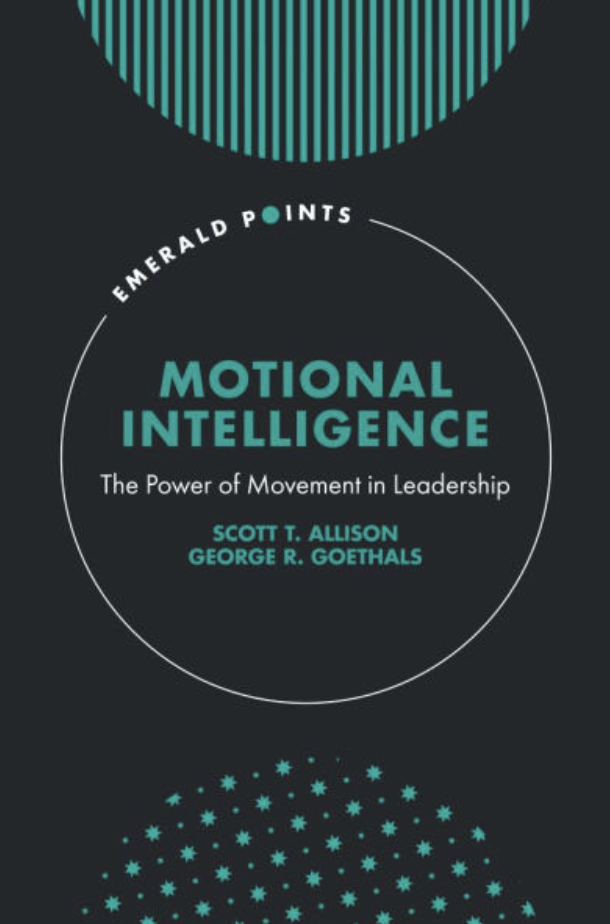
Our Latest Book: “Motional Intelligence: The Power of Movement in Leadership”

By Scott T. Allison

In 2026 we have released our new book on Motional Intelligence (MI) — a concept we believe fills a major gap in how we understand human interaction. MI refers to the ability to use body movement intentionally to influence others, to accurately read the movements of those around us, and to regulate our own physical behavior in shifting social situations. In short, it’s the intelligence of movement — the missing sibling of emotional intelligence.

Where emotional intelligence focuses on recognizing and managing feelings, MI centers on the moving body itself: posture, gesture, timing, rhythm, stillness, synchrony, and physical presence. It asks how movement shapes perception, connection, influence, and social meaning. And once you start paying attention to MI, you see it everywhere.

We form impressions of people long before they speak. Confidence, anxiety, warmth, dominance, awkwardness — we infer these qualities from motion: how someone enters a room, occupies space, approaches others, or carries themselves physically. Human beings are constant motion‑readers, often without realizing it.

Heroism, too, may depend heavily on MI. Before anyone is recognized as a hero, they are often first perceived as calm under pressure, physically decisive, emotionally grounded, or willing to step forward when others hesitate. Movement becomes the first visible signal of courage and agency.

Motional Intelligence explores this overlooked dimension of social life — and how understanding it can deepen our relationships, strengthen our leadership, and illuminate the subtle choreography of human connection.

Over Two Million People Have Visited This Heroes Blog

 People thirst for heroes. Back in 2010, on the eve of the release of our first book, Heroes: What They Do & Why We Need them, we decided to blog about them.

Little did we know that over 15 years later our heroes blog would be visited by over two million people. We’ve had visitors from all 50 states and over 260 countries.

The 20 nations who visit our blog most frequently are the U.S., Britain, Canada, France, Australia, the Philippines, India, Germany, Malaysia, Indonesia, Brazil, New Zealand, China, South Africa, Singapore, and Mexico.  We thank all of you for visiting us, leaving comments on our blog posts, and giving us helpful feedback and suggestions.

The top 10 U.S. states to visit us are, in order, California, Texas, New York, Virginia, Florida, Illinois, Pennsylvania, New Jersey, Georgia, and Ohio.

What is it about heroes that has us longing for them? Like this blog, heroism science is only a decade old, but we’re learning more and more about why the world hungers for heroes. A number of researchers have identified 12 functions of heroes:

  1. Heroes give us hope
  2. Heroes energize us
  3. Heroes develop us
  4. Heroes heal us
  5. Heroes impart wisdom
  6. Heroes are role models for morality
  7. Heroes offer safety and protection
  8. Heroes give us positive emotions
  9. Heroes give us meaning and purpose
  10. Heroes provide social connection and reduce loneliness
  11. Heroes help individuals achieve personal goals
  12. Heroes help society achieve societal goals

We’ve been studying heroes for many years and we’ve discovered many phenomena related to heroism. So please do suggest some names for us to profile, or issues for us to address in commentary pieces.  In the mean time, thanks so much for visiting us and for supporting today’s heroes.

Scott Allison and George Goethals, Professors Emeritus of Psychology and Leadership Studies

– – – – – – – – – – – – – – – – – – – – – – – – – – –


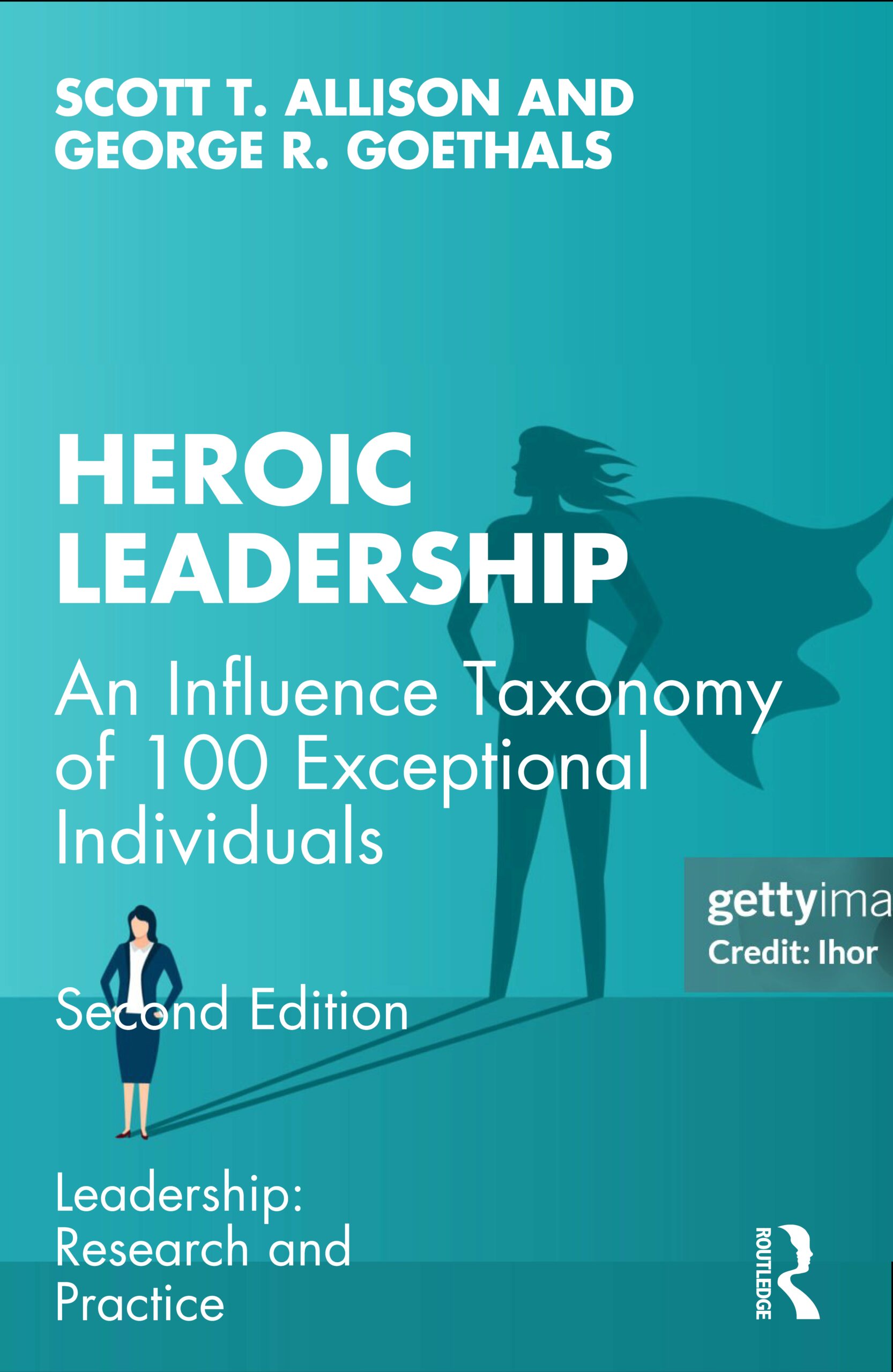
Second Edition of Our Second Book — “Heroic Leadership”

By Scott T. Allison and George R. Goethals

In this second edition of Heroic Leadership, we review the relationship between leadership and heroism, showing how our most cherished heroes are also our most transforming leaders.  We also describe in some detail a taxonomy, or conceptual framework, for differentiating among the many varieties of heroism.  Moreover, the book profiles many different individual heroes and provides an analysis of their heroic contributions.

Here’s what several distinguished reviewers have said about Heroic Leadership:

A pioneering and insightful examination of the intersection of heroes and leaders by two gifted psychologists.  Allison and Goethals’ captivating narrative  adds a new dimension to current research on leadership.”
JAMES MacGREGOR BURNS, Pulitzer Prize winning Professor Emeritus at Williams College and Distinguished Leadership Scholar at the James MacGregor Burns Academy of Leadership of the School of Public Policy at the University of Maryland.

* * * *

“Allison and Goethals’ stimulating and incisive survey of one-hundred influential leaders could not be more cogent or timely.  When so many of our leaders seem to have feet of clay and principles that bend with the prevailing breezes, they remind us of those leaders who rose to the occasion and stood firm in their moment of decision. As a result, they and their leadership have stood the test of time.  Heroic Leadership offers a refreshingly original and provocative perspective on what it means to be a great leader. Reading this book not only informs us, it also inspires!  My only suggestion would be that we expand their list to 102 — adding their names in appreciation of their heroic scholarly labors!”

RODERICK M. KRAMER, Professor of Organizational Behavior, Stanford University

* * * *

“Scott Allison and  George Goethals are pioneering scholars exploring the psychology of heroism and leadership, and this book outlines their contention that while all heroes are leaders, the converse is not true. They make their case by offering snapshots of 100 characters, some fictional (e.g., King Lear), some collective (e.g., Chilean miners, Power Rangers), and some surprising (e.g., Lady Gaga, Meryl Streep) who instantiate their taxonomy of heroes. For researchers and lay people alike, this book is packed with fascinating insights into the psychology of leadership, heroism, and mere celebrity. It is a book to be enjoyed by everyone who wonders why some people attract public attention, and others, who may deserve it (e.g., parents, soldiers, teachers) do not.”

DAVID M. MESSICK, Professor Emeritus at Northwestern University

* * * *

Presenting vivid accounts of distinguishable forms of heroism, this is a welcome contribution to understanding heroic aspects of leader-follower relations. It deserves a place as a text, reference source, and feast of revealing narratives. The accounts chosen capture what individuals’ special qualities underlie and activate others’ sense of the “heroic,” based on five factors affecting a leader’s influence. This yields ten types of heroes that are profiled, from trending and transitory to transforming and transcendent. Among those receiving attention in this cavalcade are the tragic, (Oedipus, Tiger Woods, Richard Nixon), and many shown as the “moral,” (e.g., The Dalai Lama, Mother Teresa, Rosa Parks). Insightful analyses of individual cases provide an illuminating blend of scientific scrutiny with compelling storytelling.

EDWIN P. HOLLANDER, Professor Emeritus, CUNY, Baruch College, and University Graduate Center