Monthly Archives: April 2026

The Missing Story: Why We Still Need a Shared Hero Narrative

By Scott T. Allison

If you step back and look at modern life, something feels off. We are more connected than ever, yet less unified. Stories surround us—streaming endlessly across screens—yet the kinds of shared narratives that once brought people together seem harder to find .

So what changed?

To be sure, no society has ever been perfectly unified. People have always disagreed, and cultures have always contained competing ideas. But many earlier societies did share broad narrative frameworks—religious, moral, and mythological—that helped people make sense of life.

These stories provided a kind of common language, helping answer enduring questions: Who are we? What matters? How should we live?

Over time, scholars have argued that this shared narrative ground has weakened. The sociologist Émile Durkheim warned that modern societies risk falling into anomie when shared values erode. Max Weber described an “age of disenchantment,” where scientific rationality strips the world of mystery and meaning. More recently, thinkers like Charles Taylor have suggested that while people still search for purpose, they often do so alone, without a shared framework to guide them.

But the problem is not that we lack stories. In fact, we are surrounded by them—superheroes, political identities, cultural narratives, and personal stories shaped online. The real issue is fragmentation. We have many stories, but fewer that we hold in common.

That distinction matters.

In earlier cultures, shared myths often acted as social glue. They offered not just entertainment, but a sense of belonging and direction—a narrative map of human experience. Today, that map is harder to locate.

This is where Joseph Campbell’s work becomes especially relevant. After studying myths across cultures, Campbell identified a recurring pattern he called the Hero’s Journey. In this story, an ordinary person is called to adventure, faces challenges, grows through struggle, and returns to serve others.

Campbell believed this pattern resonates because it reflects something fundamental about being human: we all face obstacles, we all change, and we all have the potential to contribute.

Of course, not every culture fits neatly into this framework. Some traditions emphasize community over individual heroes, or cyclical rather than linear stories. But even with these differences, the Hero’s Journey captures a widely recognizable pattern—one that continues to show up across time and place.

So what role might it play today?

While we may no longer share a single mythology, we can still share a common structure of meaning. The Hero’s Journey doesn’t tell us what to believe. Instead, it offers a flexible framework for understanding how growth unfolds—through challenge, courage, and transformation.

In that sense, it can serve as a kind of shared narrative grammar in a diverse world. Without something like this, it becomes harder to talk about purpose, growth, and responsibility. We risk living in separate narrative worlds, each with its own logic and values.

The Hero’s Journey offers a bridge.

It reminds us that struggle is part of life, that growth requires stepping into uncertainty, and that our journeys are not just about ourselves. At its best, it is not a story of personal triumph alone, but of return—of using what we’ve gained to help others.

This is where the idea becomes practical.

We can introduce the Hero’s Journey at home, helping children see challenges as opportunities for growth. Schools can use it to support resilience and identity development. Faith communities can connect it to traditions of transformation and service. Even organizations can use it to frame leadership and purpose.

This is not about imposing a single worldview. It is about offering a shared lens—one that is flexible enough to include many perspectives, yet structured enough to create common ground.

Because beneath our differences, we all face moments that call us forward—moments that ask us to grow, to act, and to contribute.

Perhaps myths have not disappeared. Perhaps we have simply lost sight of the patterns that still connect us.

The Hero’s Journey reminds us that even in a fragmented world, there remains a shared rhythm to human life: challenge, transformation, and return. It is not the only story we need—but it may be one of the few that can still bring us together.

And in a divided world, that may matter more than ever.

References

Allison, S. T. (2024). Hero Monomyth. In S. T. Allison, J. K. Beggan, and G. R. Goethals (Eds.), Encyclopedia of Heroism Studies. Springer.

= = = = = = = = =
Our New Book — Everyday Heroism: Courage, Compassion and the Power to Change the World

By Scott T. Allison

I’ve spent the past year co‑editing a new academic volume called Everyday Heroism: Courage, Compassion and the Power to Change the World, soon to be published by Cambridge Scholars. It’s been loads of fun working with my two co-editors Joanna Pascoe and Theresa Thorhildsen — both of these colleagues also happen to co-edit the Heroism Science journal with me.

Somewhere along the way I realized that this new Everyday Heroism book addresses something I’ve been circling for years: the idea that heroism isn’t a rare, cinematic event but a daily practice—quiet, improvised, and often unnoticed. The contributors to this volume come from psychology, education, and literary studies, and they all converge on a simple but powerful insight: ordinary people routinely meet challenge, risk, and uncertainty with courage and care. We just don’t always recognize it as heroism.

One of the joys of working on this book has been seeing how differently scholars and practitioners approach the same core question: How does heroic action emerge in everyday life? Some look to classrooms, where teachers model moral courage in the small decisions that shape a child’s sense of safety and possibility. Others turn to community settings, where people respond to adversity not with grand gestures but with steady, prosocial action—checking on a neighbor, stepping into a conflict, or offering support when it’s least convenient. Still others examine the stories we tell in literature and popular media, tracing how cultural narratives shape our sense of what courage looks like and who gets to be seen as a hero.

The book doesn’t shy away from the harder edges of heroism either. Several chapters explore the ethical tensions that arise when good intentions collide with complex realities. Others examine failure—what it means when heroic efforts fall short, and how people make sense of those moments. And a few contributors take up the role of the antihero, showing how flawed or reluctant figures can illuminate the messy, ambiguous terrain of real-world moral action.

What makes this collection especially energizing is its international scope. Authors from Europe, Oceania, and North America bring perspectives shaped by different cultural contexts, different educational systems, and different social challenges. Yet across these differences, a shared theme emerges: heroism is less about extraordinary individuals and more about the everyday choices that sustain communities and foster resilience.

If you’re interested in leadership, moral courage, or simply understanding how people rise to meet the demands of the twenty‑first century, I think you’ll find something meaningful in this volume. Editing it reminded me that heroism isn’t a distant ideal. It’s something we practice—imperfectly, creatively, persistently—every day.

I’ll keep you updated about the book’s publication date, which is probably late 2026. Here’s the exact citation:

Pascoe, J., Thorkhildsen, T., & Allison, S. T. (2027). Everyday heroism: Courage, compassion and the power to change the world. Cambridge Scholars.

= = = = = = = =

Our Definition of "Hero"

who-is-your-hero1By Scott T. Allison and George R. Goethals

We’ve written an encyclopedia article about all the various definitions of a hero, which you can view here.

Most social scientists define heroism as exceptional pro-social behavior that is voluntary and involves risk and self-sacrifice.  Although we respect that definition and recognize its value, it is important to acknowledge a more subjective approach to defining a hero.

If you haven’t read our first heroes book, our definition of a hero is based on our research on people’s stated choices of heroes. We’ve asked many hundreds of people to tell us who their heroes are, and why. From our data it’s pretty clear that in our society, heroism is in the eye of the beholder. Preferences for heroes are as varied as people’s taste in music, movies, and paintings. Defining a hero is like defining good food. It depends on your tastes, your personal experiences, and maybe even the current developmental stage of your life.

Cancer victims name cancer survivors as their heroes. Soccer players list soccer stars as their heroes. In short, your needs and motives determine whom you choose as heroes. Maturity and development play a role in hero selection, with younger people tending to choose heroes known for their talents, physical skills, and celebrity status. Older people tend to favor moral heroes. As we get older and wiser, our tastes in heroes evolve. Some have suggested that with age and wisdom, our choice of heroes improves — perhaps as we get older we become more discriminating and more respectful of the term “hero”.

The point we wish to make is that every person we have profiled in this blog is someone’s hero. We didn’t choose the heroes whom we profile on this blog — you did. Each hero may not be your personal hero, but he or she is somebody’s hero, and the reasons are valid and meaningful to the person holding them.

Even Joseph Campbell, the great mythologist and founder of the study of heroes, acknowledged that heroism is in the eye of the beholder. Campbell said, “You could be a local god, but for the people whom that local god conquered, you could be the enemy. Whether you call someone a hero or a monster is all relative….” (The Power of Myth, p. 156).

The World War II German soldier who died, said Campbell, “is as much a hero as the American soldier who was sent over there to kill him.” Campbell believed that the moral objective of heroism “is that of saving a people, saving a person, or supporting an idea.”

Although we agree with Campbell, and others, that heroism is in the eye of the beholder, we will never profile people such as Adolf Hitler in our blog, even if Hitler is considered heroic to small segment of society. There are some people whose values are so repugnant to us, and to the reasonable majority, that we will never profile them here.

We’ve found that people’s beliefs about heroes tend to follow a systematic pattern. After polling hundreds of people, we discovered that heroes are perceived to be highly moral, highly competent, or both. More specifically, heroes are believed to possess eight traits, which we call The Great Eight. These traits are smart, strong, resilient, selfless, caring, charismatic, reliable, and inspiring. It’s unusual for a hero to possess all eight of these characteristics, but most heroes have a majority of them.

As authors of this blog, we do have our own personal heroes. Our heroes combine great selflessness with great ability. In our second heroes book we call heroes of this type Traditional Heroes. One of us  (Scott Allison) identifies Roberto Clemente his greatest hero.  Clemente was a great baseball player who died helping earthquake victims. The other of us (George Goethals) calls Abraham Lincoln his greatest hero. Lincoln showed remarkable heroic leadership while healing a divided nation and freeing slaves.

When we were younger, a person didn’t have to be particularly moral or selfless to be a hero to us. The person just had to be a star athlete or great rock star.  We’ve outgrown this type of hero, which we call a Transitional Hero. Now our heroes have to accomplish far more than show great ability. They must also perform some exemplary action in the service of others.

Our research has also found that there are at least 12 functions of heroism. Heroes give us hope, heroes energize us, heroes develop us, heroes heal us, heroes impart wisdom, heroes are role models for morality, heroes offer safety and protection, heroes give us positive emotions, heroes give us meaning and purpose, heroes provide social connection and reduce loneliness, heroes help individuals achieve personal goals, and heroes help society achieve societal goals.

We will certainly continue to welcome any debates about the validity of our contentions in this blog. Critiques about the hero-worthiness of a particular individual may sharpen our thinking about who are the special men and women among us who deserve the term “hero” associated with their names. In the mean time, let’s honor the diversity of opinion out there about who our heroes are. We’re all in a different place in life, and our heroes shift and evolve as we ourselves shift and evolve.

As mentioned before, we’ve recently published the Encyclopedia of Heroism Studies, and in it we describe our current thinking about the definition of heroism.

References

Allison, S. T. (Ed.) (2022). The 12 functions of heroes and heroism. Richmond: Palsgrove.

Allison, S. T. (2023). Definitions and descriptions of heroism. In S. T. Allison, J. K. Beggan, and G. R. Goethals (Eds.), Encyclopedia of Heroism Studies. New York: Springer.

Allison, S. T., & Goethals, G. R. (2011). Heroes: What They Do & Why We Need Them.  New York: Oxford University Press.

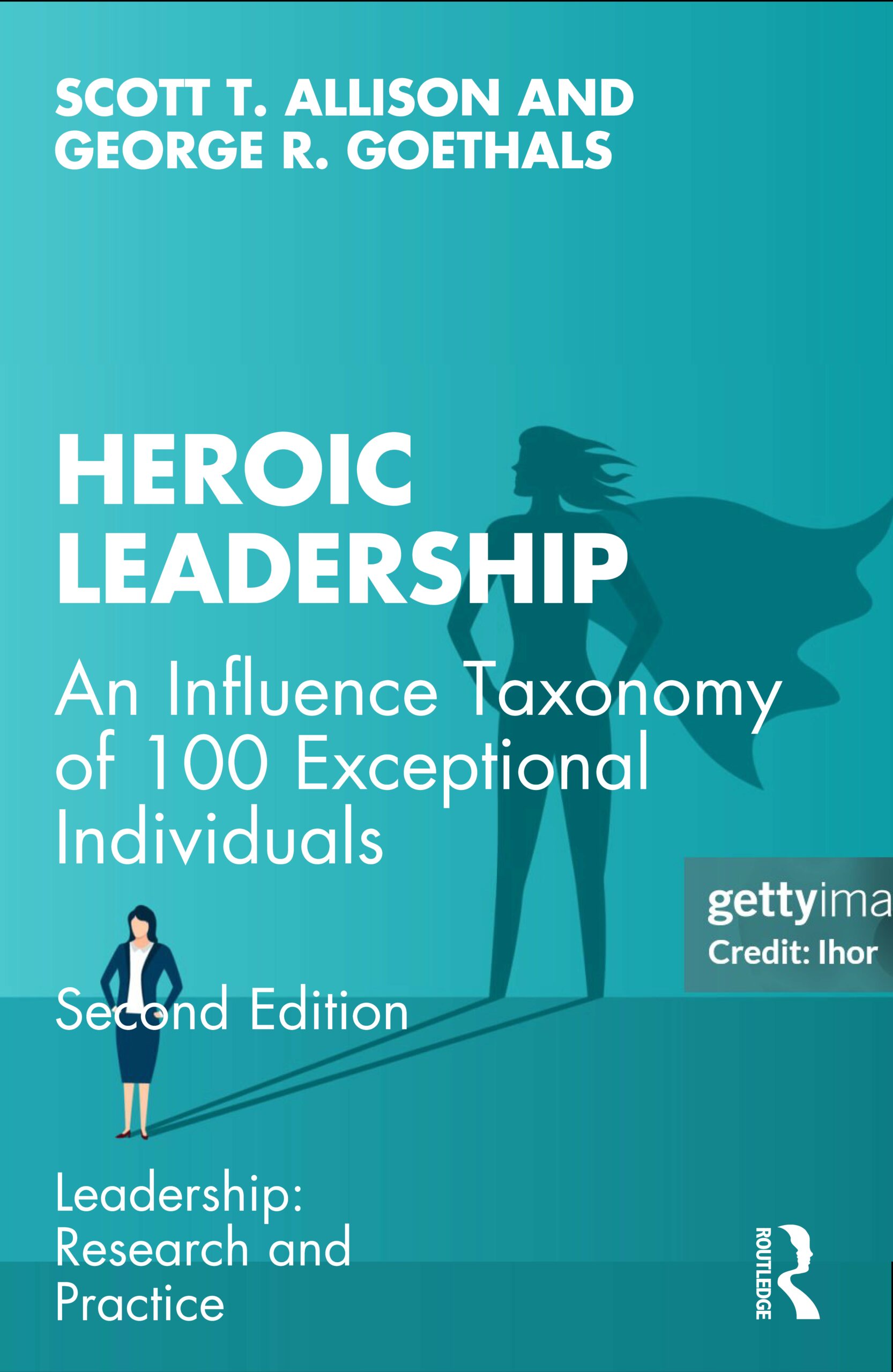
Allison, S. T., & Goethals, G. R. (2025). Heroic Leadership: An Influence Taxonomy of 100 Exceptional Individuals. New York: Routledge.

Allison, S. T., Beggan, J. K., & Goethals, G. R. (Eds.) (2024). The encyclopedia of heroism studies. Springer.

Campbell, J. (1988). The Power of Myth. (with Bill Moyers).