Tell us about where you work. What do you like about your office and location?
I work at the U.S. Attorney’s Office for the District of Columbia. Being an Assistant U.S. Attorney here is a unique experience because the office handles both federal offenses and many “state” offenses in the D.C. Superior Court. Being in D.C. also brings some pretty unique cases, such as those involving foreign embassies, the White House, and the Capitol, and also offers the opportunity to work with a wide variety of different law enforcement agencies.
Did you know coming into law school what you wanted to do? If not, how did you decide?
I came into law school thinking I wanted to be a prosecutor. While I enjoyed all of the practice areas I explored through my classes in law school, my desire to be a prosecutor was continually reaffirmed through my summer internships and my time spent in the criminal law classes.
Where did you intern for the summers during law school? What was your first job out of law school? Were those experiences helpful in exploring a practice area or landing your current job?
I interned at a Commonwealth’s Attorney’s office both summers during law school; first in Arlington County and then in Henrico County. These experiences provided hands-on experience as a prosecutor. During my 1L summer, I worked with the conviction integrity unit where I reviewed claims of innocence and provided recommendations to the Commonwealth’s Attorney. I was also able to assist in preparing a DUI trial and sit at counsel table with the prosecutor through that trial. My 2L summer I managed my own caseload; I handled discovery, plea negotiations, and was even able to handle a trial. All of this experience was invaluable as I stepped into my current role as an AUSA for the first time.
My first job out of law school was as a law clerk to a federal district court judge. Being able to be a part of the court’s decision-making process and honing my writing skills have both been extremely helpful to me since becoming an AUSA.
What courses were valuable in developing your practice interests and practical skills? What courses would you recommend?
Evidence and criminal procedure are the obvious doctrinal courses, but Advanced Criminal Trial Advocacy was the class that helped me work on and develop the practical skills I now use in my day-to-day work.
What advice would you give students on leveraging the Richmond Law network?
Don’t be afraid to reach out to alumni in the career/practice area you would like to be in after graduating. All of the alumni I know would be more than happy to answer questions or provide advice, and there is no better way to determine how best to pursue a certain career or enter a specific practice area than by speaking to someone who has already walked the path.
How did you navigate your job search out of town or out of state?
I was hired through the DOJ Honors Program, so my out-of-state job search was different from many others. I worked with the CDO and Prof. Carl Tobias to hone my application, and then used their guidance, and that of the judge I was clerking for, as I navigated the interview process. I also applied to as many different DOJ components as I could to maximize my chance of getting an interview and then an offer.
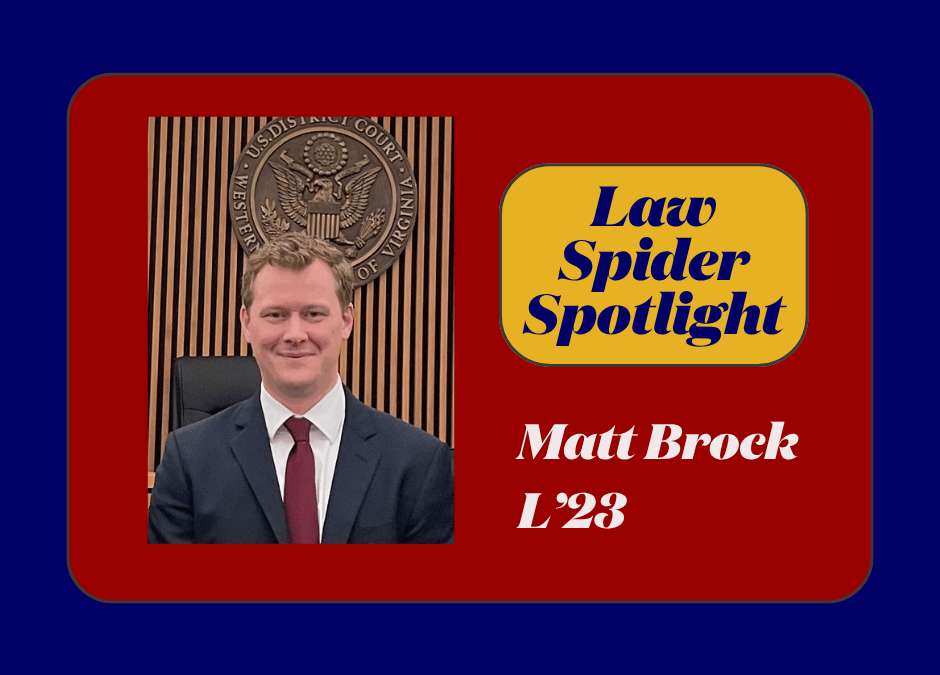
Click Matthew Brock | LinkedIn to learn more about Matt Brock (L’23).